

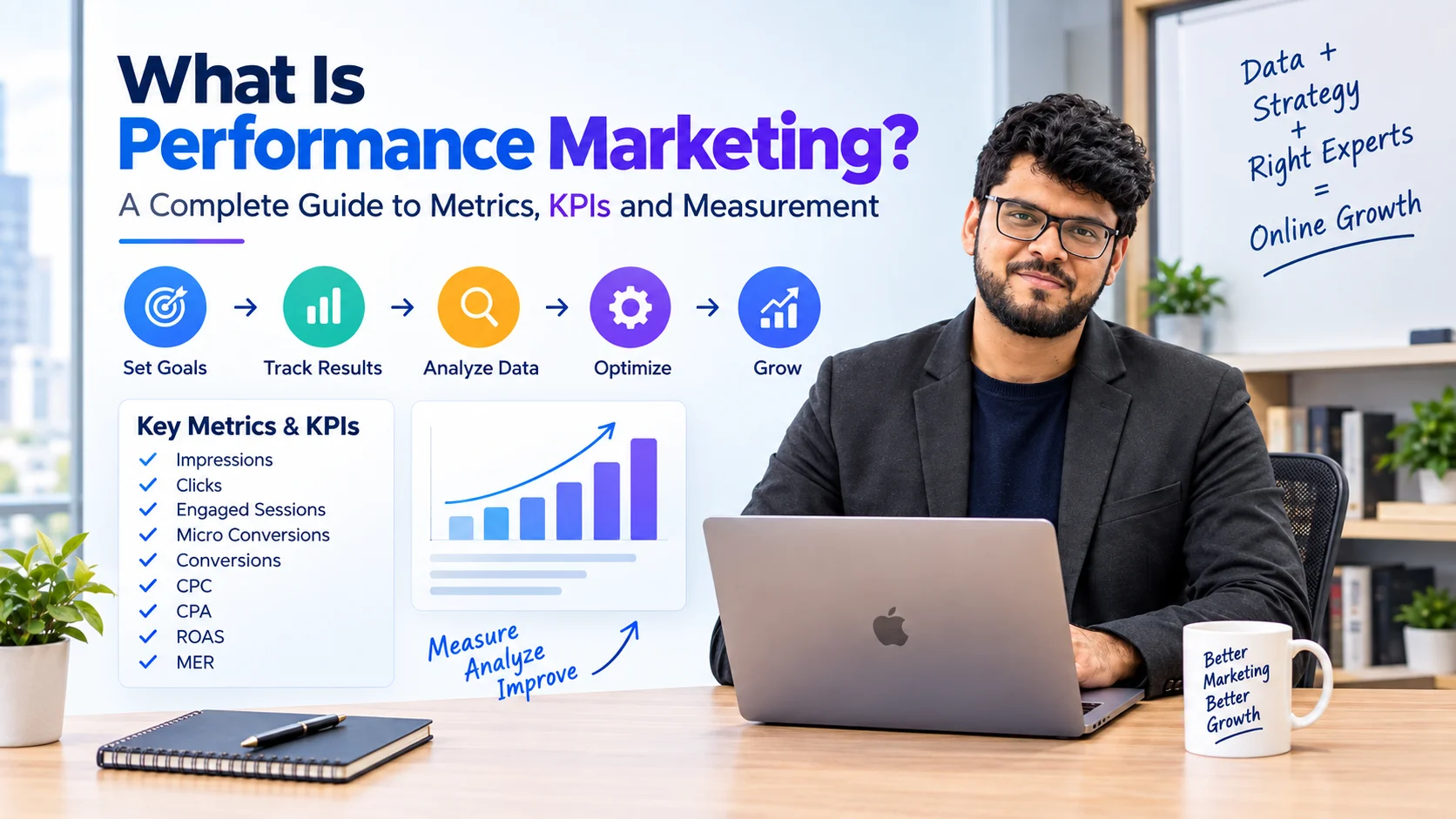
Digital marketing includes many different approaches, and terms such as digital marketing, paid marketing, and performance marketing are often used together. While these concepts are related, performance marketing has a specific focus: measuring marketing activity through results, metrics, and key performance indicators (KPIs).
What Is Performance Marketing?
Performance marketing is a measurable form of marketing in which campaign decisions are based on measurable results.
Traditionally, performance marketing has been associated with paid digital marketing channels where marketers pay based on specific actions or measurable outcomes. Examples include paying for clicks on search advertising or paying based on impressions on social advertising platforms.
However, performance marketing can be understood more broadly. If a marketing campaign has clearly defined goals, measurable results, and decisions that are continuously influenced by those results, it can be considered performance-focused marketing.
The central idea is simple:
Set a measurable goal → track the results → analyze the data → make improvements → measure the results again.
This approach helps marketers understand what is working, what needs improvement, and whether the marketing investment is producing worthwhile results.
Is Performance Marketing the Same as Digital Marketing?
Performance marketing and digital marketing are closely related, but they are not necessarily identical.
Digital marketing is a broad area that can include different marketing activities such as:
- Paid advertising
- Search engine optimization
- Content marketing
- Brand marketing
- Events and other promotional activities
- Organic campaigns
Performance marketing traditionally developed as a subset of digital marketing, particularly around paid channels because paid campaigns can often generate significant volume quickly and provide measurable data.
The important distinction is the measurement approach.
A marketing activity can be considered performance-focused when campaign decisions are strongly connected to measurable results.
For example, an organic campaign designed to generate leads, encourage people to book a demonstration, or persuade users to try a product can also be viewed through a performance marketing approach if measurable results are being used to guide decisions.
What Is the Main Goal of Performance Marketing?
The main goal of performance marketing is to measure marketing performance and use the resulting data to improve outcomes.
Depending on the business, the desired outcome could include:
- More clicks
- More engaged website visitors
- More leads
- More purchases
- More conversions
- Lower acquisition costs
- More efficient advertising spending
Performance marketing does not simply focus on launching campaigns. It involves continuously asking whether the campaign is producing the desired output from the investment being made.
Why Are Metrics and KPIs Important in Performance Marketing?
Performance marketing requires clear metrics and Key Performance Indicators (KPIs).
Without measurable goals, it becomes difficult to determine whether a campaign is performing effectively or where improvements should be made.
Clear KPIs allow marketers to:
- Define what success means.
- Measure campaign results.
- Identify problems in the customer journey.
- Develop informed hypotheses.
- Test different approaches.
- Improve campaign performance.
- Make better investment decisions.
The right KPI should always connect with the broader goals of the business.
Important Performance Marketing Metrics and KPIs
Different campaigns require different measurements. Some of the most useful metrics discussed in performance marketing include impressions, clicks, engaged sessions, conversions, CPC, CPA, ROAS, and MER.
1. Impressions
Impressions measure how many times an advertisement has appeared.
This metric helps marketers understand the amount of exposure an advertising campaign is receiving.
However, an impression alone does not necessarily indicate that a user took a valuable action. It is therefore useful to examine impressions alongside other metrics such as clicks and conversions.
2. Clicks
Click measure how many times people clicked on an advertisement.
Clicks provide an indication that users interacted with the advertisement.
However, a click is a relatively low barrier compared with deeper engagement. This is why performance marketers should continue analyzing what happens after someone clicks.
3. Engaged Sessions
An engaged session provides a stronger indication of website engagement than a basic session.
An engaged session can involve a user remaining on the website for more than 10 seconds, completing a conversion event, or viewing at least two pages or screens.
Comparing clicks with engaged sessions can reveal potential problems in the journey from advertisement to website.
For example, a large difference between clicks and engaged sessions may encourage a marketer to investigate:
- Whether the landing page matches the advertisement
- Whether the landing page communicates the expected message
- Whether the website loads efficiently
- Whether the user experience needs improvement
This analysis can help improve the conversion rate from clicks or sessions to meaningful engagement.
4. Micro Conversions
Not every valuable user action is the final conversion.
A business may have a primary conversion it wants users to complete, but other actions can also provide useful information.
Examples can include:
- Visiting a pricing page
- Searching for something on the website
- Completing another valuable website action
These smaller actions can help marketers understand how users are progressing through the marketing journey.
5. Conversions
A conversion is a desired action that a business wants users to complete.
Conversions can represent different outcomes depending on the campaign.
The important principle is to continually look for ways to improve conversion performance.
Sometimes improving the final conversion rate requires improving an earlier stage of the journey, because better performance earlier in the funnel can increase the number of users available for the final conversion.
6. Cost Per Click (CPC)
Cost Per Click (CPC) measures the cost associated with each click on an advertisement.
CPC can be analyzed at a detailed campaign level.
Different campaigns can have very different CPCs. For example, some keyword-focused campaigns may have higher CPCs than others.
A high CPC does not automatically mean that a campaign should be stopped.
The more important question is what happens further down the funnel.
If a campaign has a high CPC but produces valuable conversions at a sustainable acquisition cost, the higher click cost may still be justified.
7. Cost Per Acquisition (CPA)
Cost Per Acquisition (CPA) measures how much it costs to acquire a customer or desired acquisition.
CPA is important because it helps answer a fundamental business question:
Is the marketing investment sustainable?
Marketers need to compare what they are spending with what they are receiving in return.
This can also help businesses understand how much they can reasonably invest to generate additional customers based on the value produced.
Sustainable growth requires understanding the relationship between marketing input and business output.
Performance Marketing Reporting
Performance marketing data is also important when reporting results to management or business decision-makers.
Reports can help explain:
- Whether marketing is sustainable
- Which areas are producing valuable results
- Where investment could potentially be increased
- Where investment may need to be reduced
- Which campaigns require further analysis
- How marketing contributes to business growth
For example, if one advertising channel is generating a strong acquisition cost compared with another, the performance data can be used to support a discussion about additional investment.
The important point is that investment decisions should be supported by measurable campaign data.
First-Time Buyers and Customer Value
For e-commerce businesses, performance marketing analysis can become more detailed.
One useful question is:
How much should a business be willing to spend to acquire a first-time buyer compared with a returning customer?
The answer can depend on the longer-term value of that customer.
For example, businesses can analyze whether customers who spend more during their first purchase generate a different lifetime value compared with customers who initially spend less.
This type of analysis can help businesses understand whether acquiring certain types of customers justifies a higher acquisition cost.
What Is ROAS in Performance Marketing?
ROAS stands for Return on Advertising Spend.
ROAS measures the return generated from advertising spend and is commonly used to evaluate individual advertising channels.
One useful way to analyze ROAS is to examine how it changes over time.
A channel may initially produce strong returns, but its efficiency can change as investment increases. Monitoring ROAS over time can therefore help marketers identify whether advertising spend is becoming less efficient.
ROAS is particularly useful when analyzing the performance of individual channels.
What Is MER in Performance Marketing?
MER stands for Marketing Efficiency Ratio.
It looks at marketing efficiency at a broader level.
The source defines MER as:
MER = Total Revenue ÷ Total Ad Spend Across Marketing Channels
While ROAS can be used to examine individual channels, MER provides a broader view of the overall efficiency of marketing efforts.
This makes it useful when evaluating marketing performance as a whole rather than looking at only one advertising channel.
CPA vs ROAS vs MER
These metrics answer different questions.
| Metric | What It Helps Measure |
|---|---|
| CPC | How much is being paid for a click |
| CPA | How much it costs to acquire a customer or acquisition |
| ROAS | Return generated from advertising spend |
| MER | Overall marketing efficiency across advertising channels |
Using multiple metrics can provide a more complete picture than relying on one number alone.
How Does Performance Marketing Improve Campaigns?
Performance marketing follows a continuous measurement and optimization process.
A basic performance-focused process looks like this:
1. Define the goal
Determine the outcome the campaign is designed to produce.
2. Select measurable KPIs
Choose metrics that show whether the campaign is moving toward the goal.
3. Collect campaign data
Monitor impressions, clicks, engagement, conversions, costs, and other relevant metrics.
4. Identify gaps
Look for differences between stages of the marketing journey.
5. Develop hypotheses
Use the available data to identify possible reasons for performance differences.
6. Test improvements
Make changes and evaluate whether they produce better results.
7. Measure again
Continue monitoring performance and adjust the campaign based on the results.
This creates a continuous cycle of measurement, analysis, testing, and optimization.
Why Is Data Important in Performance Marketing?
Data allows marketers to move beyond assumptions.
For example, if many people click an advertisement but relatively few become engaged website visitors, the data creates a reason to investigate the next step of the journey.
Similarly, if a campaign has a high CPC, marketers can examine what happens after the click before deciding whether the campaign is inefficient.
This is why performance marketing is not simply about reducing individual costs.
A low CPC, for example, may not be valuable if the resulting traffic does not generate meaningful outcomes.
The broader objective is to understand the relationship between marketing inputs and business outputs.
How Should Businesses Choose Performance Marketing KPIs?
Businesses should choose KPIs that are directly connected to their overall business goals.
Useful questions include:
- What outcome is the campaign expected to generate?
- Is the objective clicks, leads, purchases, or another conversion?
- What does each customer acquisition cost?
- Is the marketing investment sustainable?
- Which channels are producing valuable results?
- Are customers generating enough value to justify acquisition costs?
- Is marketing efficiency changing over time?
The most useful KPIs are therefore not necessarily the metrics that look impressive in isolation. They are the metrics that help explain what is driving growth and contributing to new customers.
Is Performance Marketing Only Paid Marketing?
No. Performance marketing has traditionally been associated with paid marketing, but it can be understood more broadly as measurable marketing.
Paid campaigns are commonly associated with performance marketing because they can generate volume quickly and provide data that is relatively easy to track.
However, an organic campaign can also have a performance-oriented approach when it has measurable objectives and campaign decisions are based on measurable results.
The challenge with some organic campaigns is that they may generate less volume and less data, making it harder to test changes and determine exactly what influenced a conversion.
What Makes Performance Marketing Different?
The defining characteristic of performance marketing is measurability.
Rather than simply asking whether marketing activity exists, performance marketing asks:
What happened as a result of the marketing activity?
This creates a more structured approach to campaign management.
Marketers can connect activities with measurable outcomes, identify opportunities for improvement, and use performance data to make future decisions.
How Social Click Can Help With Performance Marketing
Choosing and managing digital marketing services can be difficult because every business has different goals, audiences, budgets, and requirements.
Social Click helps businesses connect with relevant digital marketing specialists and understand their available service options.
For businesses considering performance marketing, Google Ads, social media advertising, SEO, content marketing, or other digital marketing services, the right approach depends on the specific business requirement.
Social Click provides guidance and consultation assistance to help businesses understand these options before moving forward. Through its trusted digital marketing network, businesses can access relevant specialists and receive transparent information about potential services and approaches.
The focus is on helping businesses make informed digital marketing decisions rather than navigating the process alone.
Final Thoughts
Performance marketing is fundamentally about measuring marketing activity and using the results to make better decisions.
Although the term has traditionally been associated with paid digital channels, a broader definition focuses on measurable marketing. Clear goals, relevant KPIs, campaign data, testing, and continuous optimization form the foundation of this approach.
Metrics such as CPC, CPA, ROAS, and MER can help businesses understand different aspects of marketing efficiency. At the same time, metrics such as impressions, clicks, engaged sessions, micro conversions, and conversions help marketers understand what is happening throughout the customer journey.
Ultimately, effective performance marketing requires more than looking at individual numbers. Businesses need to connect marketing metrics with their broader goals and determine whether the results justify the investment.
For businesses that need help understanding performance marketing or choosing the right digital marketing service, Social Click provides guidance, consultation assistance, service comparison, and access to a trusted digital marketing network.
Start your digital marketing journey with informed guidance and the right expertise for your business.
Frequently Asked Questions About Performance Marketing
Performance marketing is a measurable form of marketing where campaign performance is tracked using defined metrics and KPIs. The results are then used to improve campaigns and make informed marketing decisions.
Common performance marketing KPIs and metrics include impressions, clicks, engaged sessions, micro conversions, conversions, CPC, CPA, ROAS, MER, and the percentage of first-time buyers.
Performance marketing has traditionally been associated with paid marketing because paid channels are highly measurable and can generate volume quickly. However, performance marketing can also be understood more broadly as marketing based on measurable results.
CPC means Cost Per Click. It measures the cost associated with each click generated by an advertisement.
CPA means Cost Per Acquisition. It helps businesses understand the cost required to generate an acquisition and evaluate whether marketing spending is sustainable.
ROAS means Return on Advertising Spend. It is used to evaluate the return generated from advertising spending, particularly when analyzing individual marketing channels.
MER means Marketing Efficiency Ratio. It provides a broader view of marketing efficiency by comparing total revenue with total advertising spend across marketing channels.
KPIs provide measurable targets that help marketers evaluate campaign performance, identify problems, test improvements, and make better investment decisions.
SEO is traditionally treated separately from paid performance marketing. However, an organic campaign can be approached as performance marketing when it has measurable goals and campaign decisions are based on measurable results.
There is no single metric that applies to every campaign. The appropriate KPI depends on the business objective. The most useful metrics are those connected to overall business goals, growth, and customer acquisition.