Looking for expert help? See our SEO services in Delhi.
What is On-Page SEO?
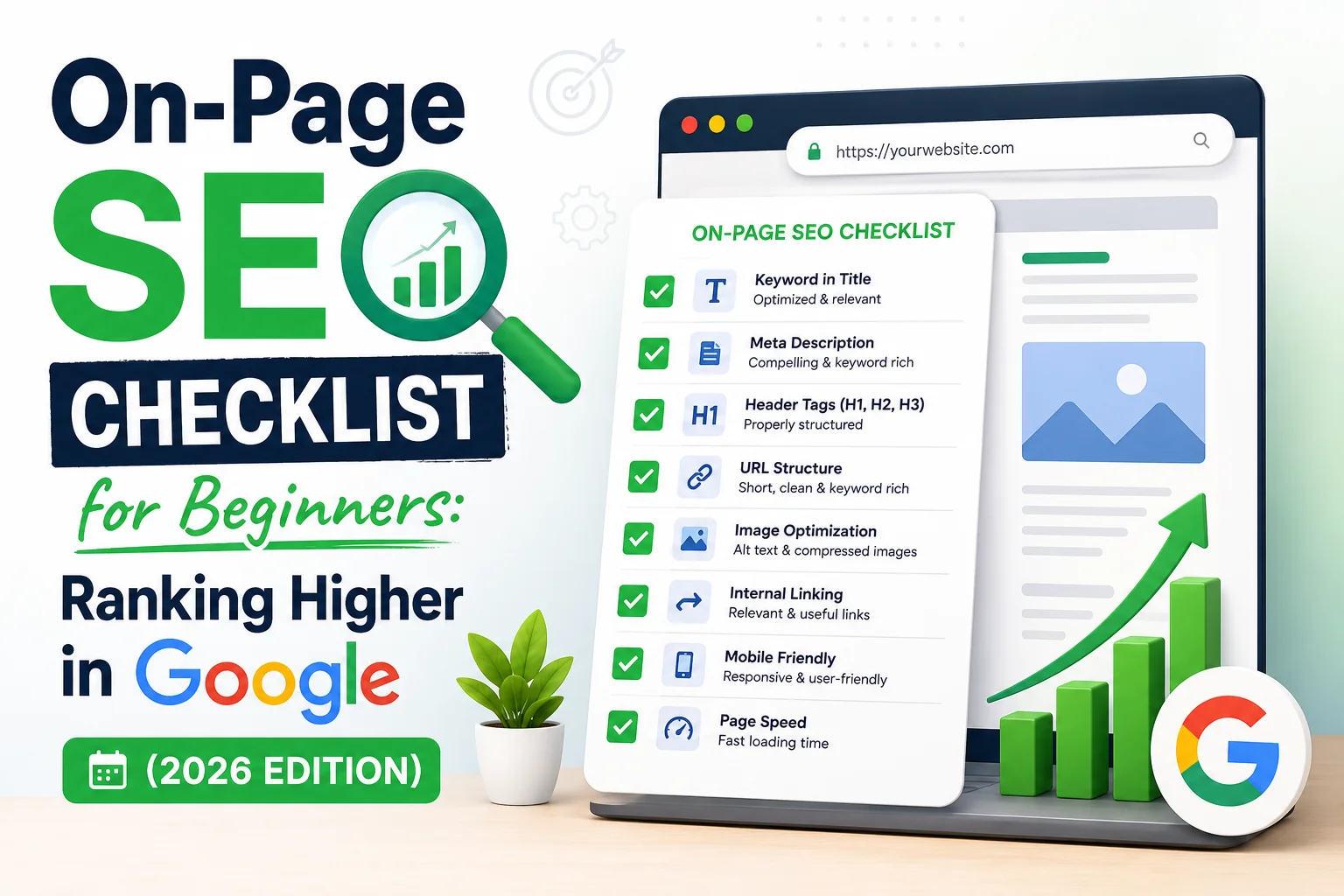
On-page SEO is the entire process of making changes to your website pages so you can rank better in Google search results From optimizing for content, headings and title tags to images, internal links as well as page speed. If you consider on-page SEO: You are organizing your shop in a manner where customers and Google can figure out what offerings you have.
SEO has long arrived in 2026. Google is smarter than ever. They are not just ranking pages because the keyword is in every bit of text. Google instead is taking the stance of search intent, user experience but helpful content and authority signals. That means, if your page solves the user problem better than competing pages … you have a much higher chance of ranking.
According to the latest SEO studies of 2026, it is no surprise that search intent matching (at point), content quality and Core Web Vitals continue as some of the strongest ranking signals.
Why On-Page SEO Matters in 2026
Ranking in Google today is no longer just about backlinks. Even a high-authority website can struggle if its on-page SEO is poor. Why? Because Google needs clarity.
Ask yourself this: when Google crawls your page, does it instantly understand:
- What your page is about?
- Who it is for?
- Whether it satisfies search intent?
If the answer is no, ranking becomes difficult.
Google AI Overviews are also changing search behavior. Studies show many users now get quick answers directly in search results, making competition for clicks even tougher. Your page must be highly optimized to win visibility and clicks.
Keyword Research Before Content Writing
Before writing a single word, you need keyword research.
This is where beginners make mistakes. They write first and optimize later. That approach rarely works.
Find:
- Primary keyword
- Secondary keywords
- LSI keywords
- Long-tail keywords
Example for this blog:
Primary Keyword: On-Page SEO Checklist
Secondary Keywords: on-page SEO techniques, SEO optimization tips
LSI Keywords: Google ranking factors, SEO-friendly content, meta tags, internal linking, Yoast SEO
Use tools like:
- Google Keyword Planner
- Semrush
- Ahrefs
Search Intent Optimization
Every keyword has intent:
- Informational
- Commercial
- Transactional
- Navigational
Your content must match intent perfectly. If someone searches “on-page SEO checklist”, they want actionable steps—not theory.
LSI Keywords and Semantic SEO
Google now understands context better than exact-match keywords.
That’s where LSI keywords help.
Examples:
- SEO audit checklist
- website optimization
- technical SEO
- page experience signals
- search engine ranking
Using related terms naturally improves topic relevance.
Avoid keyword stuffing. Write naturally. Search engines prefer semantic depth over repetition.
SEO-Friendly URL Structure
Your URL should be short, clean, and descriptive.
Good:example.com/on-page-seo-checklist
Bad:example.com/post?id=12345&seo=abc
Best practices:
- Keep URLs short
- Include primary keyword
- Avoid unnecessary symbols
Clean URLs improve both rankings and user trust.
Title Tag Optimization
Your title tag is one of the most important on-page SEO factors.
Google uses it to understand page context, and users use it to decide whether to click.
Best practices:
- Keep under 60 characters
- Include target keyword near start
- Add power words
Example:
On-Page SEO Checklist for Beginners (2026 Guide)
Optimized title tags can improve rankings and CTR significantly.
Best Practices for Higher CTR
Want more clicks? Use:
- Numbers
- Years
- Power words
- Emotional triggers
Examples:
- Ultimate Guide
- Beginner Friendly
- Step-by-Step
Meta Description Optimization
Meta descriptions don’t directly improve rankings, but they improve CTR.
Keep it:
- Under 155 characters
- Keyword-rich
- Compelling
Example:
Learn the ultimate on-page SEO checklist for beginners in 2026. Improve Google rankings with practical SEO tips, Yoast optimization, and LSI keywords.
A strong meta description increases clicks from search results.
Heading Structure (H1, H2, H3)
Headings organize your content.
Google uses them to understand page hierarchy.
Rules:
- One H1 only
- Multiple H2s allowed
- H3 under H2
Structure helps both SEO and readability.
Example:
- H1 Main Topic
- H2 Main Section
- H3 Subsection
This improves crawling and user experience.
Optimize Blog Content for Yoast SEO
If you use WordPress, Yoast SEO is extremely useful.
Yoast checks:
- Keyword placement
- Readability
- Internal linking
- Meta optimization
Aim for green scores—but don’t obsess over 100%.
Yoast is a guideline, not Google.
Readability Optimization
Yoast rewards readable content.
Checklist:
- Short sentences
- Active voice
- Transition words
- Small paragraphs
Good readability keeps visitors engaged longer.
Yoast recommends a strong readability score with short sentences and low passive voice usage.
Internal Linking Strategy
Internal links connect one page to another on your website.
Benefits:
- Pass authority
- Improve crawlability
- Increase session duration
Example:
If writing about SEO, link to:
- Keyword research guide
- Technical SEO guide
- Backlink strategy
Use descriptive anchor text.
Bad: Click here
Good: Complete SEO checklist
Image SEO Optimization
Images improve engagement—but only if optimized.
Checklist:
- Compress images
- Add ALT text
- Use descriptive file names
- Convert to WebP
Example:
Bad filename: IMG001.jpg
Good filename: on-page-seo-checklist-2026.jpg
Google Image Search can drive additional traffic.
Core Web Vitals & Page Speed
Page speed is a major ranking factor.
Important metrics:
- LCP under 2.5s
- CLS under 0.1
- Fast loading on mobile
Slow websites lose traffic and rankings.
Tools:
- PageSpeed Insights
- GTmetrix
Fast sites improve user satisfaction and rankings.
Mobile-Friendly SEO
Most Google searches now happen on mobile.
Your website must:
- Load fast
- Be responsive
- Be easy to navigate
Test with:
Google Mobile-Friendly Test
If mobile UX is poor, rankings suffer.
Schema Markup
Schema helps search engines understand your content better.
Popular schema types:
- FAQ
- Article
- Product
- Review
Benefits:
- Rich snippets
- Better visibility
- Higher CTR
Schema gives extra context to Google.
E-E-A-T Signals
Google values:
- Experience
- Expertise
- Authoritativeness
- Trustworthiness
Improve E-E-A-T by adding:
- Author bio
- Contact details
- Case studies
- Real examples
Trust matters more than ever in 2026.
Google rewards helpful content created by credible sources.
Conclusion
On-page in 2026 is creating specified user-oriented content and turning Google into your best friend. Forget about those days where all you needed to do was add some keywords. In today’s world, success is the result of a blend of keyword research, alignment to search intent signals (including topic modeling), technical optimization as appropriate for that content’s ranking factors calculus and user experience.
Your chances of ranking higher in Google skyrocket with implement this On-Page SEO Checklist. Begin with Fundamentals — titles, headings, meta descriptions and content optimisation. Next in you can work on advanced factors like schema, Core Web Vitals and E–E-A-T signals.
SEO is not magic. It’s consistency.