
Choosing a digital marketing agency for a small business is an important decision. The right agency can help you turn your business goals into a practical digital strategy, while the wrong fit can create confusion, wasted time, and unnecessary expense.
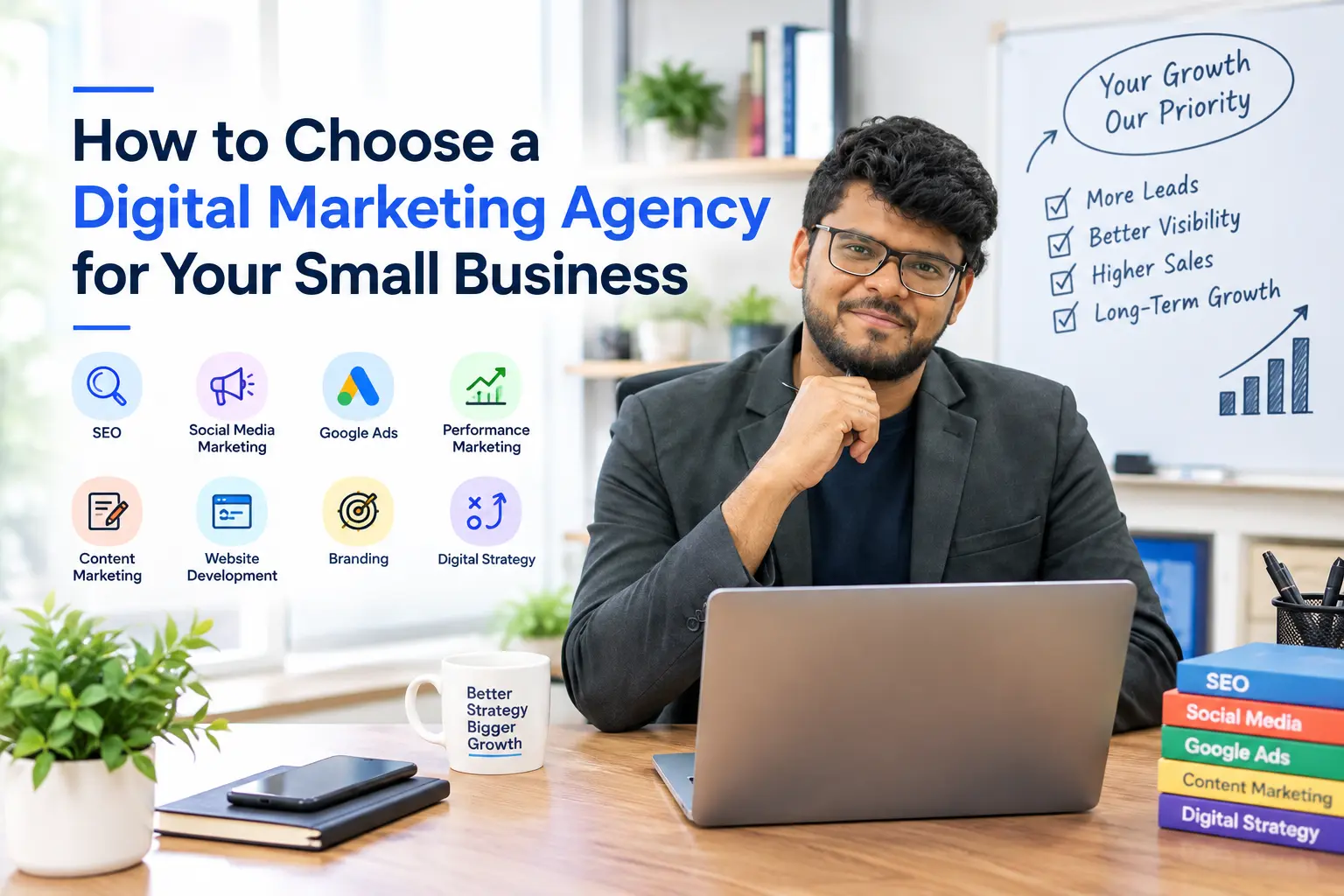
With so many agencies offering services such as SEO, social media marketing, Google Ads, content marketing, performance marketing, website development, branding, and digital strategy, it can be difficult to know where to begin.
The answer is not simply to choose the agency with the biggest portfolio or the lowest price.
A better approach is to first understand what your business needs, then evaluate an agency’s expertise, experience, portfolio, process, team, reviews, pricing, cultural fit, and use of AI.
This guide explains how to choose a digital marketing agency for a small business step by step.
READ MORE: Why Every Business Needs a Digital Marketing Agency in 2026
What Is a Digital Marketing Agency?
A digital marketing agency is a professional service provider that helps businesses plan, manage, and improve their online marketing activities.
Depending on its expertise, an agency may provide services such as:
- Search engine optimization (SEO)
- Social media marketing
- Google Ads and paid advertising
- Performance marketing
- Content marketing
- Website development or improvement
- Branding
- Digital marketing strategy
- Lead generation
- Marketing consultation
However, every agency is different.
Some agencies specialize in particular services, industries, or types of marketing campaigns. Others provide a broader range of digital marketing services.
That is why choosing an agency should begin with your business requirements, rather than with the agency itself.
Why Choosing the Right Digital Marketing Agency Matters
Small businesses often have limited time, resources, and marketing budgets. This makes it particularly important to understand what you are buying and who you are working with.
A digital marketing relationship involves more than purchasing a service.
You may be working with an agency for strategy, campaign planning, implementation, reporting, communication, and ongoing improvements.
A suitable agency should therefore understand your objectives and clearly explain:
- What services you need
- Why those services are relevant
- How the work will be approached
- Who will work on your account
- How communication will happen
- How progress will be measured
- What the expected investment will be
- How the agency uses technology and AI to improve its work
The goal is to make an informed decision instead of choosing an agency based only on appearance, price, or promises.
How to Choose a Digital Marketing Agency for a Small Business
1. Start With Your Business Goals
Before searching for a digital marketing agency, identify what you actually want to achieve.
This is the first and most important step because different business goals require different areas of expertise.
For example, your business may want to:
- Build a new website
- Improve an existing website
- Develop a new brand
- Improve an existing brand
- Generate more leads
- Improve digital marketing campaigns
- Expand into a new market
- Increase online visibility
- Improve social media activity
- Strengthen search engine visibility
- Develop a broader digital marketing strategy
You may have several objectives at the same time.
Write them down before speaking with agencies.
Why should you define your goals first?
Because not every digital marketing agency specializes in everything.
An agency may offer many services but have deeper experience in only certain areas. If your primary requirement is SEO, for example, you should investigate the agency’s SEO experience. If your primary requirement is paid advertising, examine its experience with relevant advertising campaigns.
The objective is to find an agency whose expertise is relevant to your most important business requirement.
Ask yourself:
What exactly do I need the agency to accomplish?
A clear answer to this question makes the rest of the selection process much easier.
2. Evaluate the Agency's Expertise and Experience
Once you understand your goals, examine the expertise and experience of the agencies you are considering.
Different agencies have different strengths.
One agency may have strong experience in SEO. Another may focus heavily on social media. Another may have extensive website development experience. Some may work across several digital marketing disciplines.
Look for experience that matches your requirements.
For example:
| Your Requirement | What to Investigate |
|---|---|
| New website | Website development experience |
| Website improvement | Experience improving existing websites |
| Branding | Branding and brand-development experience |
| Lead generation | Previous lead-generation campaign experience |
| SEO | SEO expertise and relevant examples |
| Social media | Social media marketing experience |
| Paid advertising | Advertising and campaign management experience |
| Content marketing | Content strategy and content creation experience |
| Broader strategy | Digital marketing strategy and consultation experience |
The key question is simple:
Has this agency done the type of work my business actually needs?
Do not select an agency simply because it describes itself as a full-service agency. Look deeper into where its practical experience lies.
3. Review the Portfolio and Case Studies
An agency’s website can tell you what services it offers, but its portfolio and case studies can provide a better understanding of the type of work it has actually handled.
Review the agency’s portfolio carefully.
Look for projects that are relevant to:
- Your industry
- Your business size
- Your marketing requirements
- Your desired outcomes
- The services you are considering
For example, if your objective is lead generation, look for evidence that the agency has worked on lead-generation campaigns.
If you need a new website, look for website projects.
If you require social media marketing, investigate the agency’s social media work.
The same principle applies to other services.
What should you look for in a portfolio?
Ask:
- Has the agency handled similar projects?
- Does the work match my requirements?
- Does the agency show completed projects clearly?
- Are there case studies related to the service I need?
- Does the agency appear comfortable discussing its previous work?
You can also examine the agency’s own digital presence.
Look at its:
- Website
- Social media profiles
- Video content
- Other relevant online platforms
This gives you additional opportunities to understand what the agency actually does and what type of work it presents publicly.
4. Understand the Agency's Process
A good digital marketing relationship requires more than good ideas.
It also requires a clear process.
Before hiring an agency, ask it to explain how it works from the beginning of the relationship through ongoing delivery.
Important areas to understand include:
- Discovery
- Strategy
- Onboarding
- Implementation
- Communication
- Reporting
- Performance measurement
- Ongoing support
A clear process helps establish expectations for both sides.
Questions to Ask About the Process
Ask the agency:
How will you understand my business?
What happens during onboarding?
How will you develop the strategy?
How often will we communicate?
How regularly will you provide reports?
How will I know whether the work is progressing properly?
How will you measure success?
The answers should be clear and consistent.
If different people involved in the sales process describe the agency’s process differently, it may be worth asking additional questions before making a decision.
Why does process matter?
Digital marketing cannot simply be launched without understanding the business, its objectives, audience, requirements, and expectations.
A structured process creates the foundation for asking the right questions and identifying the details that can affect campaign performance.
For a small business, this structure can also make the relationship easier to manage because you know what happens next and who is responsible for each part of the work.
5. Evaluate the Team That Will Work on Your Business
You are not only hiring an agency.
You are also hiring the people who will work with you.
This is an important distinction.
During the sales process, ask exactly who will be responsible for your account after you become a client.
Find out:
- Who will manage the account?
- Who will work on the strategy?
- Who will handle implementation?
- What experience does the team have?
- What are their qualifications?
- How many accounts are they managing?
- Who will be your primary point of contact?
- What happens if that person becomes unavailable?
One important question is whether the people presenting the agency during the sales process will actually be involved in delivering the work.
You want clarity about the transition from sales to implementation.
Ask Who Will Actually Deliver the Work
The people you meet during the sales process may not necessarily be the same people responsible for day-to-day execution.
Therefore, ask:
Who will actually work on my account?
Understanding this before signing an agreement can help prevent misunderstandings later.
The depth of experience within the delivery team matters because digital marketing requires practical execution, not just a strong presentation.
6. Look at the Agency's Systems and Support
People are important, but systems are important too.
Consider what happens if your main contact becomes unavailable for an extended period.
If all project information exists only with one person, work can become difficult to continue.
A structured agency should have systems that help organize information, communication, project details, briefs, and ongoing work.
Ask how the agency manages:
- Project information
- Communication
- Client requirements
- Briefs
- Campaign information
- Ongoing tasks
- Account history
The purpose is not to investigate the agency’s internal tools for their own sake.
The important question is:
Can someone else understand the status of my account and continue the work if the primary contact is unavailable?
Good systems can make continuity easier and reduce dependence on a single individual.
7. Check Reviews and What Other Clients Are Saying
Do not rely entirely on what an agency says about itself.
Look for independent reviews and feedback from other clients.
Online reviews can provide another perspective on the client experience.
However, do not look only at the overall star rating.
Read the actual comments.
Look for what people say about:
- Communication
- Service
- Professionalism
- Support
- Delivery
- Experience working with the agency
The details within reviews can be more useful than a simple numerical rating.
You can also look at the platforms where the agency receives reviews and see whether feedback is available across relevant online channels.
Reviews should not be the only factor in your decision, but they can provide additional information alongside the agency’s portfolio, process, team, and experience.
8. Consider Pricing and Overall Value
Price is naturally important for a small business.
However, choosing a digital marketing agency based only on the cheapest quote can create problems.
Digital marketing requires time, expertise, planning, execution, and ongoing effort.
A very low price may not provide the level of service your business actually requires.
At the same time, a higher price does not automatically mean better value.
The better approach is to consider the complete picture.
Look for:
- Transparent pricing
- Clear service descriptions
- Clear deliverables
- Realistic expectations
- A clear process
- Relevant expertise
- Appropriate team experience
- Communication and reporting
- Overall value for your requirements
Be particularly careful when an agency makes excessive promises while presenting an unusually attractive price.
Instead of asking only:
“How much does it cost?”
also ask:
“What am I receiving for this investment?”
and:
“Does the service match what my business actually needs?”
After evaluating the agency’s expertise, portfolio, process, team, reviews, and fit, you can make a more informed assessment of whether the proposed investment makes sense for your business.
9. Assess Cultural Fit and Communication
Digital marketing is often an ongoing relationship.
That means personal and cultural compatibility can matter.
An agency can have relevant experience and strong work, but the relationship may still become difficult if communication styles, expectations, or working approaches do not align.
Consider how you feel during the initial conversations.
Ask yourself:
- Was communication comfortable?
- Did the agency listen to your requirements?
- Did it understand your concerns?
- Did it explain things clearly?
- Did you feel comfortable asking questions?
- Does its working style seem compatible with yours?
- Does the agency understand businesses similar to yours?
A good client-agency relationship requires communication in both directions.
You should be able to explain your business requirements, ask questions, discuss concerns, and understand the agency’s recommendations.
Why Is Cultural Fit Important?
Digital marketing involves collaboration.
The agency may need information from your business, feedback on campaigns, clarification about customers, and decisions regarding strategy or execution.
If communication is difficult, the entire process can become harder.
For that reason, cultural and working-style compatibility should be considered alongside technical expertise.
10. Ask How the Agency Uses AI
AI is becoming an important part of modern digital marketing workflows.
When evaluating a digital marketing agency, ask how it uses AI and how AI contributes to its work.
The important question is not simply:
“Do you use AI?”
A more useful question is:
“How does AI improve the work you deliver for clients?”
AI can support different areas of digital marketing.
AI for Content Creation
AI can assist with:
- Brainstorming
- Drafting
- Content optimization
- SEO-related content workflows
The agency should be able to explain how AI fits into its content process.
AI for Design
AI-powered design tools can assist with:
- Creating visuals
- Developing layouts
- Improving images
- Supporting design workflows
This can help agencies handle certain design requirements more efficiently.
AI for Website Development
AI can also support technical workflows.
For example, it can assist with:
- Creating blocks of code
- Identifying coding problems
- Debugging
- Supporting integrations
- Improving development workflows
The objective is to use AI to make development processes more efficient while maintaining appropriate quality.
AI for Personalization and Audience Segmentation
AI can also support customer and marketing data workflows.
It can help with:
- Audience segmentation
- Data enrichment
- Personalization
- Creating more relevant audience groups
Better audience segmentation can support more relevant engagement.
Questions to Ask an Agency About AI
Ask:
- How are you using AI in your workflow?
- Does AI support content creation?
- Do you use AI for design?
- How does AI assist website development?
- How do you use AI for audience segmentation?
- How does AI improve efficiency?
- What parts of your work are enhanced by AI?
The purpose is to understand whether the agency has a practical approach to AI rather than simply mentioning AI as a marketing term.
What Questions Should You Ask a Digital Marketing Agency?
Before choosing an agency, prepare a list of questions.
Here is a practical checklist:
About Business Goals
- What information do you need about my business?
- Which digital marketing services are relevant to my objectives?
- What should we prioritize first?
About Expertise
- What services do you specialize in?
- How much experience do you have with the service I need?
- Have you worked on similar requirements?
About Portfolio
- Can you show relevant examples of previous work?
- Do you have case studies related to my requirements?
- What types of businesses have you worked with?
About Process
- How does onboarding work?
- How do you develop the strategy?
- How often will we communicate?
- How frequently will I receive reports?
- How will success be measured?
About the Team
- Who will manage my account?
- Who will develop the strategy?
- Who will execute the work?
- How experienced is the delivery team?
- What happens if my main contact is unavailable?
About Pricing
- How is your pricing structured?
- What is included?
- Are there additional costs?
- What exactly will I receive for the proposed investment?
About AI
- How are you using AI?
- Which parts of your workflow use AI?
- How does AI improve the service you provide?
Clear answers to these questions can help you understand the agency before committing to a long-term relationship.
Digital Marketing Agency Selection Checklist for Small Businesses
Before making your final decision, review the following checklist:
- I have clearly defined my business goals.
- I understand which digital marketing services I need.
- The agency has relevant expertise.
- The agency has experience related to my requirements.
- I have reviewed its portfolio.
- I have looked at relevant case studies.
- I understand the agency’s process.
- I know who will work on my account.
- I understand the team’s experience.
- I know how the agency handles communication.
- I know how reporting and measurement work.
- I have checked independent reviews.
- I understand the pricing.
- I have considered value rather than price alone.
- I am comfortable with the agency’s communication style.
- I understand how the agency uses AI.
- I know what happens after signing the agreement.
If several of these questions remain unanswered, gather more information before moving forward.
How Social Click Can Help Small Businesses Choose Digital Marketing Services
Choosing digital marketing services can be challenging when you are not sure which service, specialist, or approach is appropriate for your business.
Social Click is designed to make that process easier.
Rather than leaving businesses to navigate digital marketing decisions alone, Social Click acts as a bridge between businesses and digital marketing experts.
The focus is on trusted guidance, transparent information, expert consultation, and access to relevant digital marketing services.
Every business has different requirements, which is why the process begins with understanding the business in detail.
Based on those requirements, Social Click can help businesses explore relevant digital marketing specialists and service options.
Digital Marketing Services Supported Through Consultation
Depending on the business requirement, businesses can explore support related to:
- SEO
- Social Media Marketing
- Google Ads
- Performance Marketing
- Content Marketing
- Digital Marketing Strategy
- Other relevant digital marketing services
The objective is to make the digital marketing journey clearer, more informed, and easier to manage.
Why Business-Specific Guidance Matters
There is no single digital marketing service that automatically suits every business.
One business may need stronger search visibility.
Another may need social media support.
Another may need paid advertising.
Another may require content marketing.
Another may need broader digital marketing strategy and consultation.
That is why understanding the business before recommending a service is important.
Social Click’s approach is based on this principle.
The process focuses on:
- Understanding the business.
- Identifying relevant requirements.
- Explaining available digital marketing service options.
- Connecting the business with relevant digital marketing specialists.
- Providing support throughout the process.
This gives businesses a clearer path toward selecting digital marketing services that are relevant to their needs.
What Makes a Digital Marketing Agency a Suitable Fit?
There is no single characteristic that determines whether an agency is suitable for every business.
Instead, examine the complete relationship.
A suitable agency should have relevant expertise, experience, a clear process, capable people, reliable systems, understandable pricing, effective communication, and a working approach that fits your business.
You should also understand how the agency measures success and how it incorporates modern tools such as AI into its workflow.
The selection process should therefore be based on information rather than assumptions.
Common Mistakes to Avoid When Choosing a Digital Marketing Agency
Choosing Only on Price
The cheapest agency is not necessarily the right fit for your requirements.
Compare the complete service, expertise, process, team, and value.
Choosing Only Because of a Flashy Portfolio
A visually impressive portfolio does not automatically mean the agency has experience with your specific requirement.
Look for relevant work.
Ignoring the Delivery Team
Find out who will actually manage and execute your work after the sales process.
Not Asking About the Process
A lack of clarity about onboarding, communication, reporting, and measurement can create confusion later.
Believing Every Promise
Be cautious of excessive promises, particularly when they are combined with unusually low pricing.
Ignoring Reviews
Look beyond what the agency says about itself and examine what clients say about their experiences.
Forgetting About Cultural Fit
A technically capable agency still needs to communicate and collaborate effectively with your business.
Treating AI as Just a Buzzword
Ask how AI is actually integrated into the agency’s workflow and how it improves the service.
Final Thoughts
Choosing a digital marketing agency for a small business involves more than comparing prices or looking at attractive websites.
Start with your goals.
Then investigate the agency’s expertise and experience. Review its portfolio and case studies. Understand its process. Find out who will actually work on your account. Examine its systems and support. Read reviews. Consider pricing and overall value. Assess communication and cultural fit. Finally, ask how the agency is using AI to improve its workflow.
The most important objective is to make an informed digital marketing decision.
Your agency should understand your business, communicate clearly, explain its services transparently, and provide the expertise relevant to your requirements.
At Social Click, the focus is on helping businesses navigate these decisions with free expert guidance, consultation assistance, transparent service and cost comparison, and access to a trusted digital marketing network.
If you are unsure which digital marketing service your business needs or which type of specialist is relevant, getting guidance before making a commitment can make the process considerably clearer.
Start your digital marketing journey with the right information, the right guidance, and a clear understanding of what your business actually needs.
Frequently Asked Questions About Choosing a Digital Marketing Agency
Start by defining your business goals. Then evaluate agencies based on relevant expertise, experience, portfolio, process, team, reviews, pricing, cultural fit, and use of AI. Choose based on how closely the agency’s capabilities match your actual requirements.
A small business should look for relevant expertise, experience with similar requirements, a clear process, an experienced delivery team, transparent pricing, understandable reporting, good communication, and appropriate digital marketing support.
Not necessarily. An agency may offer many services while having deeper expertise in particular areas. The important consideration is whether its strongest capabilities match your business goals.
A portfolio can help you understand the type of work an agency has completed. Review whether the examples are relevant to your industry, requirements, and desired service.
Ask about its expertise, previous work, process, onboarding, communication, reporting, team, pricing, account management, and use of AI. You should also ask who will actually deliver the work.
Price should not be the only factor. Digital marketing requires time, expertise, and ongoing work. Compare pricing with the services, team, process, experience, and overall value being provided.
Ask who will manage your account, who will handle strategy, who will execute the work, what experience they have, and how many accounts they manage. Also ask what happens if your primary contact becomes unavailable.
AI can support content creation, design, website development, debugging, audience segmentation, data enrichment, and other workflows. Asking about AI helps you understand how the agency is adapting its processes and using technology to improve its work.
Social Click provides guidance, consultation assistance, service comparison, and access to a trusted digital marketing network. Businesses can explore relevant specialists and services based on their specific requirements.