Looking for expert help? See our Google Ads management services in Delhi.
Digital marketing and performance marketing are often treated as two completely separate career and business paths. This can create confusion, especially for beginners who are trying to understand which area they should learn or which type of marketing service their business actually needs.
The reality is more straightforward.
Performance marketing is a focused part of the broader digital marketing industry. Digital marketing covers multiple online marketing channels, while performance marketing focuses more deeply on paid advertising, tracking, conversion optimization, media planning, funnels, and measurable business results.
This difference does not mean that digital marketing has become outdated or that performance marketing has replaced it. Both areas continue to have their own roles, skills, and career paths.
For businesses, the right choice depends on their requirements, goals, available resources, and the type of digital marketing support they need.
For beginners, the choice depends on the skills they want to develop and whether they prefer broad digital marketing knowledge or deeper specialization in paid advertising and performance-focused activities.
Know More :- What Is Performance Marketing?
Quick Answer: What Is the Difference Between Digital Marketing and Performance Marketing?
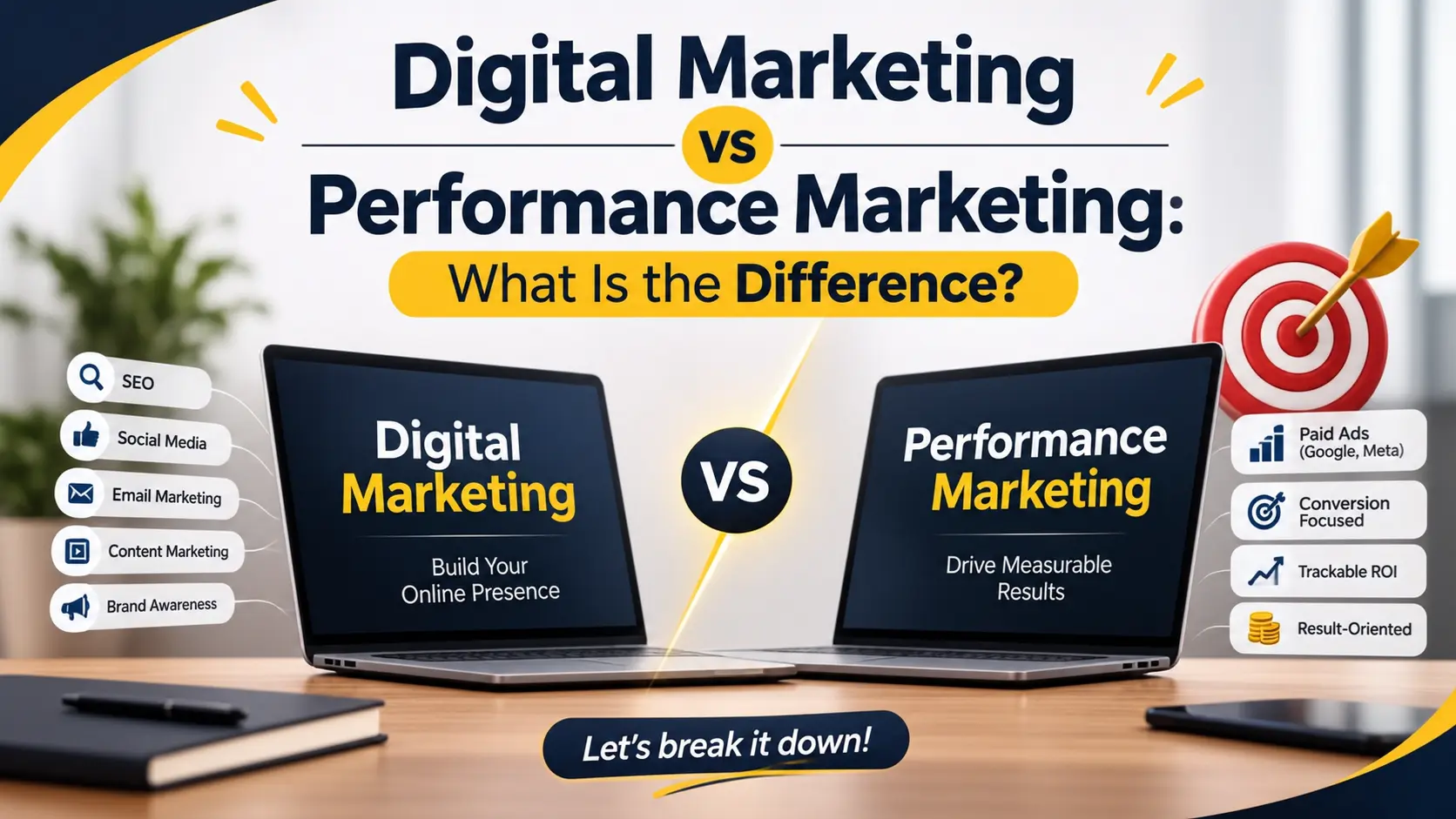
Digital marketing is a broad field that covers multiple online marketing activities, while performance marketing is a more specialized area that focuses primarily on paid advertising, tracking, optimization, and measurable results.
A digital marketing approach may include:
- Search engine optimization (SEO)
- Paid advertising
- Email marketing
- Organic social media
- Content marketing
- Website and CMS management
- Analytics and reporting
- Tracking and pixels
- AI-assisted marketing activities
Performance marketing generally goes deeper into:
- Paid advertising
- Google Ads
- Meta Ads
- Tracking
- Pixels and tags
- Attribution
- Conversion rate optimization (CRO)
- Media planning
- Funnels
- Lead strategies
- CRM integrations
- Forecasting
- Revenue planning
Therefore, digital marketing provides broader exposure across marketing channels, while performance marketing provides deeper specialization in paid and measurable marketing activities.
Is Performance Marketing a Part of Digital Marketing?
Yes.
Performance marketing can be understood as a specialized part or subset of digital marketing.
Earlier, performance marketing was commonly included as a module within broader digital marketing learning. As demand for paid media and performance-focused activities increased, dedicated performance marketing courses and specialized learning paths became more common.
This evolution does not mean performance marketing came after digital marketing as a completely separate industry.
Instead, performance marketing has existed within the broader digital marketing environment and has increasingly developed into a more focused specialization.
This distinction is important because it helps explain why the two areas overlap so much.
A person learning digital marketing may learn the fundamentals of performance marketing along with SEO, content, social media, email marketing, analytics, and other areas.
A person specializing in performance marketing may spend considerably more time developing deeper knowledge of paid advertising, tracking, attribution, conversion optimization, media planning, and related activities.
Digital Marketing and Performance Marketing: Core Difference
The easiest way to understand the difference is through breadth versus specialization.
| Digital Marketing | Performance Marketing |
|---|---|
| Broader marketing discipline | More specialized marketing discipline |
| Covers multiple digital channels | Focuses heavily on paid and measurable activities |
| Includes SEO, content, social media, email and paid ads | Focuses primarily on paid ads, tracking and optimization |
| Provides wider surface-level exposure | Provides deeper knowledge in selected areas |
| Useful for understanding the overall digital ecosystem | Useful for specializing in performance-driven campaigns |
| Can lead to diversified digital marketing roles | Can lead toward specialized performance marketing roles |
The difference is not about one field replacing the other.
Instead, they represent different levels of focus within the same broader digital marketing environment.
What Is Digital Marketing?
Digital marketing is the broader practice of promoting and supporting businesses through digital channels.
A standard digital marketing learning path can cover several different modules. The purpose is to help a beginner understand how different parts of online marketing work together.
Depending on the learning program, digital marketing can include:
Search Engine Optimization
SEO focuses on improving a website’s visibility through organic search activities.
A learner may understand basic on-page SEO, website optimization, content-related activities, and other foundational SEO concepts.
Paid Advertising
Paid advertising introduces learners to advertising platforms and the basic concepts behind running paid campaigns.
This can include understanding how paid campaigns work and how advertising platforms are used to reach potential customers.
Analytics and Reporting
Analytics helps marketers understand what is happening on a website or across digital marketing activities.
Reporting and measurement are important because marketing decisions require an understanding of available data.
Tracking, Pixels, and Tags
Tracking allows marketers to understand activities and interactions that occur through digital campaigns.
Pixels and tags form part of the tracking environment used to collect relevant marketing information.
Website and CMS Management
Digital marketing can also involve working with websites and content management systems.
A CMS such as WordPress may be part of a beginner’s practical learning because websites are an important part of many digital marketing activities.
Email Marketing
Email marketing remains another component of the broader digital marketing mix.
Organic Social Media
Digital marketing can also include organic social media activities, such as planning and managing content for social platforms.
Content Marketing
Content plays an important role in communicating information, attracting audiences, and supporting different digital marketing activities.
AI-Assisted Marketing
Digital marketing learning has also evolved with the use of AI.
AI can be applied to different activities depending on the task. For example, when working on on-page SEO, AI can be used to support certain implementation and content-related activities.
The important point is that AI does not remove the need to understand digital marketing fundamentals. Instead, marketers need to understand how and when to use AI effectively.
What Is Performance Marketing?
Performance marketing is a more focused area of digital marketing that primarily revolves around paid advertising and measurable outcomes.
The major focus is generally on paid advertising platforms and the systems required to track and optimize their performance.
Two major advertising platforms discussed in the source material are:
- Google Ads
- Meta Ads
However, simply knowing how to create advertisements is not enough for deeper performance marketing work.
A performance-focused marketer also needs to understand what happens before, during, and after an advertising campaign.
This can involve:
- Campaign planning
- Tracking
- Attribution
- Conversion rate optimization
- Media planning
- Funnel development
- Lead strategies
- CRM integrations
- Forecasting
- Revenue planning
The purpose is to connect advertising activity with measurable business outcomes.
What Does a Performance Marketer Actually Work On?
A performance marketing role can involve much more than launching advertisements.
Paid Advertising
Paid ads are one of the central areas of performance marketing.
The marketer may work with advertising platforms, create campaigns, manage budgets, and monitor campaign activity.
Tracking and Attribution
When money is being spent on advertising, understanding where results are coming from becomes important.
Tracking, pixels, tags, and attribution help marketers understand campaign activity and the sources contributing to results.
Conversion Rate Optimization
Conversion rate optimization, or CRO, is another part of performance marketing.
The focus is on improving the journey from traffic to the desired action.
Media Planning
Performance marketing also involves deciding how advertising budgets should be distributed across different channels or platforms.
A marketer may need to consider:
- Which platform should receive more budget?
- What result is expected from a particular channel?
- How should the available media budget be planned?
- How should different campaigns work together?
Funnels and Lead Strategies
Performance marketing can also involve developing funnels and lead-generation strategies.
The aim is to understand how users move through different stages before completing a desired action.
CRM Integrations
Advertising data may also need to connect with CRM systems.
This allows businesses to better understand the journey from advertising activity to leads and other business outcomes.
Forecasting and Revenue Planning
At a more advanced level, performance marketing can involve forecasting and revenue planning.
This requires marketers to think beyond individual advertisements and consider how marketing activity connects with broader business planning.
How Long Does It Take to Learn Digital Marketing?
According to the provided discussion, a standard digital marketing course may take approximately 2.5 to 3.5 months when structured appropriately.
Within this period, a beginner can learn the different areas of digital marketing at a surface level.
However, learning a subject during a course is different from developing deep practical expertise.
In-depth knowledge generally develops through:
- Internships
- Practical projects
- Company experience
- Working with real campaigns
- Working with real websites
- Applying marketing concepts in practical situations
A course can provide the foundation needed to begin a career, while practical experience helps develop deeper expertise.
How Long Does It Take to Learn Performance Marketing?
The provided discussion describes a focused performance marketing course as potentially taking around 1.5 to 2 months, depending on how the course is structured.
The shorter duration is largely connected to the narrower scope.
Instead of covering many areas of digital marketing, the learner focuses more deeply on performance-related topics such as:
- Paid advertising
- Google Ads
- Meta Ads
- Tracking
- Pixels and tags
- Attribution
- CRO
- Media planning
- Funnels
- Lead strategies
- CRM integrations
- Forecasting
- Revenue planning
The exact depth still depends on the learning structure and the amount of practical work involved.
Does Learning Digital Marketing Mean You Will Not Get a Job?
No.
Learning broad digital marketing can lead to entry-level opportunities where a person works across several marketing activities.
A beginner may start with an internship and then move into a digital marketing executive role.
In some businesses, particularly smaller businesses or in-house teams, there may not be enough work to justify having a separate specialist for every marketing function.
For example, one person may work on:
- Some SEO activities
- Content management
- Website-related tasks
- Organic social media
- A small paid advertising campaign
- Google Ads
- Meta Ads
This does not mean the role has no growth potential.
As a business grows, its marketing requirements can also become more specialized. Different responsibilities may eventually be handled by dedicated team members.
Digital Marketing Career Path
A broad digital marketing path can begin with an internship and progress through roles such as:
Digital Marketing Intern → Digital Marketing Executive → Senior Digital Marketing Executive → Digital Marketing Manager → Marketing Manager
The exact job titles can vary between organizations.
The important point is that a broad digital marketing background can provide exposure to several different areas.
As someone gains experience, they may begin managing specialists working in areas such as:
- SEO
- Google Ads
- Meta Ads
- Content
- Social media
- Digital marketing execution
Therefore, starting with broad knowledge does not automatically limit long-term career development.
Performance Marketing Career Path
A more specialized performance marketing path can develop through roles such as:
Performance Marketing Intern → Performance Marketing Executive → Senior Performance Marketing Executive → Performance Marketing Manager → Growth Manager → Head of Performance Marketing or Head of Growth
Again, job titles can differ between organizations.
The central difference is the area of specialization.
A performance-focused professional generally continues developing deeper expertise around paid advertising, tracking, optimization, media planning, funnels, and measurable outcomes.
Can You Move From Digital Marketing to Performance Marketing?
Yes.
A person can first develop broad digital marketing knowledge and later specialize in performance marketing.
For example, someone may initially learn:
- SEO
- Content marketing
- Organic social media
- Paid advertising
- Email marketing
- Website management
- Analytics
After developing a foundation, they may decide to focus specifically on Google Ads, Meta Ads, tracking, or other performance-related areas.
They can then pursue additional learning to develop deeper expertise.
This route can be useful for someone who wants to understand the wider digital marketing ecosystem before choosing a specialization.
Can You Move From Performance Marketing to Digital Marketing?
A performance marketing professional can also broaden their knowledge over time.
However, specialization naturally means that some areas outside the primary field may receive less attention.
Someone who spends most of their time managing paid campaigns may not work as deeply with:
- SEO
- Organic social media
- Content marketing
- Email marketing
- Broader website activities
This does not mean those skills cannot be learned later.
It simply reflects the trade-off between broad knowledge and specialized depth.
Is Digital Marketing Dead Because Performance Marketing Is Growing?
No.
The growth of performance marketing does not mean digital marketing has disappeared.
SEO continues to be part of digital marketing.
Organic social media continues to provide opportunities for businesses to distribute content.
Content marketing remains part of the broader digital marketing environment.
Email marketing is another established digital channel.
Websites and content management systems also continue to play a role in digital business activity.
Analytics and reporting remain important for understanding digital performance.
The broader lesson is that digital marketing continues to evolve rather than simply disappearing.
Why Organic Social Media Still Matters
Organic social media is another example of why digital marketing cannot be reduced to paid advertising alone.
Social platforms can provide businesses with opportunities to distribute content and reach audiences organically.
Educational, informational, and entertainment-focused content can be used to build reach and attract attention.
Businesses can then use social platforms as part of a broader funnel, directing interested audiences toward websites, offers, or other digital channels.
This demonstrates how different digital marketing activities can work together.
What Role Does AI Play in Digital Marketing?
AI is increasingly becoming part of digital marketing workflows.
However, the important skill is not simply knowing that AI exists.
Marketers need to understand how to use AI appropriately for different marketing tasks.
For example, AI can support activities related to:
- On-page SEO
- Content development
- Data analysis
- Reporting
- Marketing research within available data
- Digital marketing workflows
Analytics tools can also incorporate AI-based capabilities that help users ask questions about their available marketing data and receive basic insights or reports.
The underlying marketing knowledge remains important because marketers need to understand what questions to ask, how to interpret information, and where AI can actually support their work.
Digital Marketing or Performance Marketing: Which One Should You Learn?
There is no single path that applies to every beginner.
The decision should depend on what you want to learn and the type of work you want to pursue.
A broader digital marketing path may suit someone who wants to:
- Understand multiple digital marketing channels
- Learn SEO
- Understand content marketing
- Work with organic social media
- Learn email marketing
- Understand paid advertising fundamentals
- Work with websites and CMS platforms
- Build a diversified digital marketing foundation
A performance marketing path may suit someone who wants to:
- Focus heavily on paid advertising
- Work with Google Ads
- Work with Meta Ads
- Learn tracking and attribution
- Understand media planning
- Work with funnels and lead strategies
- Learn CRO
- Understand CRM integrations
- Work with forecasting and revenue planning
The choice ultimately depends on the individual’s current knowledge, interests, and intended direction.
Can You Learn Both Digital Marketing and Performance Marketing?
Yes.
A learner can start with broad digital marketing knowledge and later study performance marketing in greater depth.
For example:
Digital Marketing Foundation → Practical Experience → Performance Marketing Specialization
This can provide broad exposure first and deeper specialization later.
Another approach is to start with performance marketing and eventually expand into SEO, content, organic social media, and other areas.
Both directions are possible.
The key consideration is what skills you currently have and which skills you need to develop next.
What Is the Main Trade-Off Between Digital Marketing and Performance Marketing?
The main trade-off is breadth versus depth.
With broader digital marketing learning, you are exposed to multiple marketing disciplines.
With specialized performance marketing learning, you spend more time going deeper into paid advertising and performance-focused activities.
Neither approach automatically determines your entire career.
Your practical experience, specialization, continuous learning, and ability to apply your knowledge can influence how your career develops.
A person can also change direction later.
How Businesses Can Choose the Right Digital Marketing Support
For businesses, the decision should begin with understanding the actual requirement.
Not every business needs the same combination of digital marketing services.
One business may need SEO and content support.
Another may need social media and content planning.
Another may need paid advertising and performance marketing.
Some businesses may need multiple services working together.
This is why understanding the business situation should come before selecting a service.
At Social Click, the focus is on helping businesses understand their digital marketing options and connect with relevant digital marketing specialists through a trusted network.
The approach is designed around understanding the business, explaining service options clearly, providing consultation assistance, and supporting businesses throughout the decision-making process.
Businesses can seek guidance for areas including:
- SEO
- Social Media Marketing
- Google Ads
- Performance Marketing
- Content Marketing
- Other digital marketing services
The objective is to make the digital marketing journey more informed, transparent, and straightforward.
How Social Click Can Help With Digital Marketing Decisions
Choosing between different digital marketing services can be difficult when a business does not know which area it actually needs.
Social Click provides guidance and consultation assistance to help businesses understand their options.
The support includes:
- Free expert guidance
- Quick consultation support
- Transparent service and cost comparison
- Access to a trusted digital marketing network
- Assistance in finding relevant digital marketing experts
Instead of treating every business in the same way, the approach starts with understanding the business requirement and then identifying relevant digital marketing support.
This can be particularly useful when a business is unsure whether it needs SEO, paid advertising, performance marketing, social media marketing, content marketing, or a combination of services.
Conclusion
The difference between digital marketing and performance marketing becomes much easier to understand when you look at their scope.
Digital marketing is broad. Performance marketing is specialized.
Digital marketing can introduce learners to SEO, paid advertising, analytics, tracking, websites, email marketing, organic social media, content marketing, and AI-assisted workflows.
Performance marketing focuses more deeply on paid advertising, Google Ads, Meta Ads, tracking, attribution, CRO, media planning, funnels, lead strategies, CRM integrations, forecasting, and revenue planning.
Performance marketing has not replaced digital marketing. It has developed as a more specialized area within the broader digital marketing environment.
For beginners, both paths can lead to different types of roles and career development. Someone can start broadly and specialize later, or start with a specialized area and expand their knowledge over time.
For businesses, the important question is not simply whether digital marketing or performance marketing is better. The more useful question is:
What does the business actually need right now?
A business may require SEO, content, social media, paid advertising, performance marketing, or several of these services together.
That is where informed guidance becomes valuable.
Social Click helps businesses understand digital marketing service options, compare relevant services, receive consultation assistance, and connect with trusted digital marketing experts through its network.
The right digital marketing journey starts with understanding your requirements clearly, selecting relevant expertise, and building the skills or services around your actual business needs.