



Looking for expert help? See our Google Ads management services in Delhi.
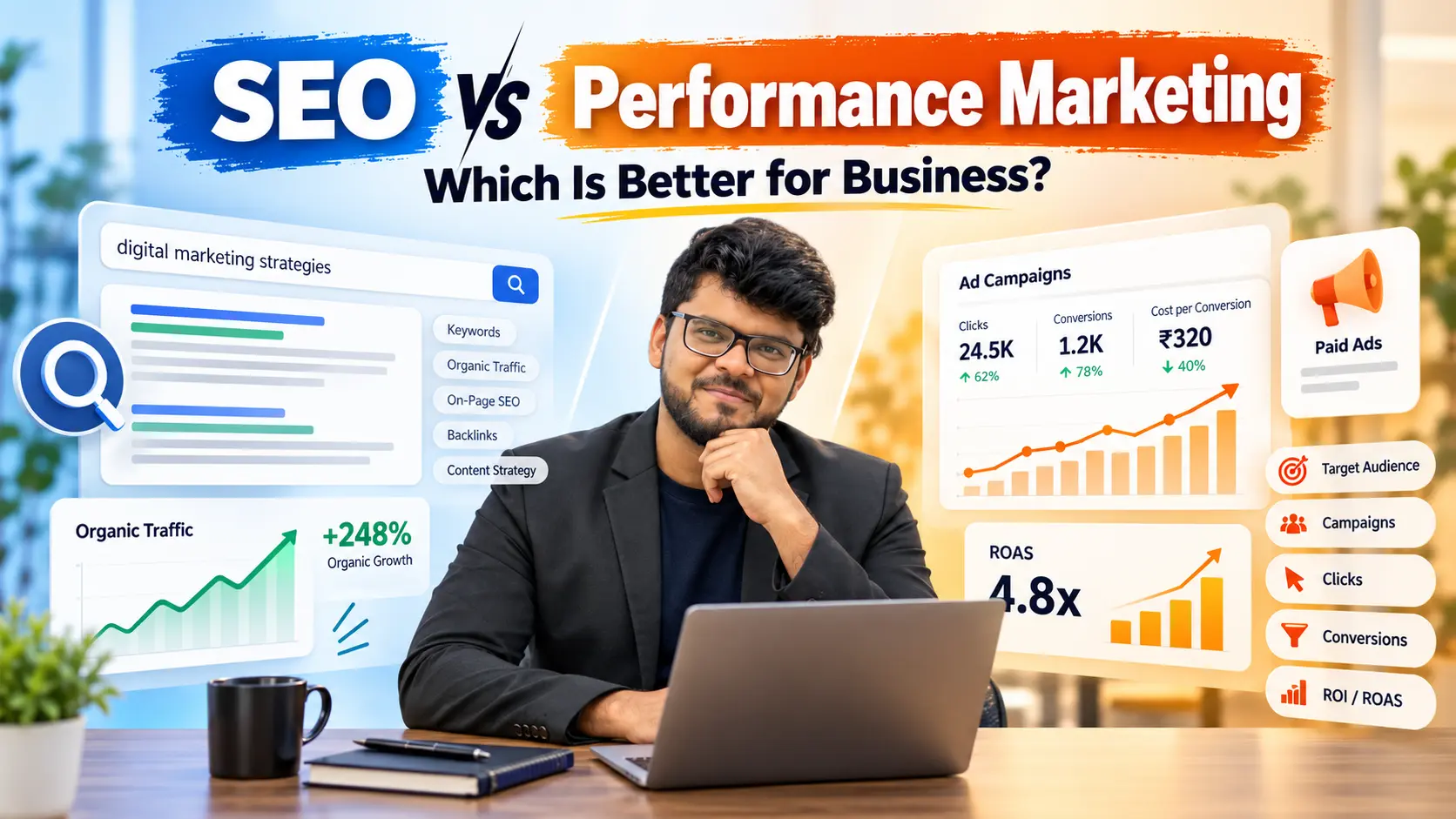
Choosing between SEO and performance marketing is one of the most important decisions when planning a digital marketing strategy. Both approaches help businesses attract website visitors, generate leads, and increase online visibility. However, they work differently, require different investments, and deliver results over different timeframes.
SEO is designed for sustainable, long-term growth, while performance marketing focuses on generating measurable results through paid campaigns. The right choice depends on your business goals, marketing budget, and how quickly you need results.
For most businesses, combining both strategies can create a balanced approach to digital growth.
Let’s understand how SEO and performance marketing work, their differences, and how to choose the right strategy for your business.
What Is SEO (Search Engine Optimization)?
Search Engine Optimization (SEO) is the process of improving a website to achieve higher rankings in organic search engine results. It helps businesses attract visitors without paying for every click.
When a website ranks well for relevant search queries, it can receive consistent traffic from people actively looking for information, products, or services.
Key Benefits of SEO
Long-term visibility: SEO helps businesses establish a lasting presence in search results.
No cost per click: Organic visitors do not require a direct payment for each website click.
Compounding returns: Once a website achieves strong rankings, it can continue attracting traffic over time.
Evergreen traffic: Informational articles, product pages, and evergreen content can generate visitors long after publication.
Sustainable growth: SEO supports consistent online visibility rather than relying entirely on paid advertising.
However, SEO requires patience. Businesses typically need three to six months or more to see meaningful results, depending on their website and marketing efforts.
What Is Performance Marketing?
Performance marketing is a results-oriented digital marketing approach in which businesses invest in paid campaigns to achieve measurable objectives, such as website traffic, leads, or conversions.
Paid search advertising, commonly known as Pay-Per-Click (PPC), is one of the approaches used within performance marketing.
With PPC, businesses bid on relevant keywords to display advertisements in search results. They pay when someone clicks on their advertisement.
Key Benefits of Performance Marketing
Immediate traffic: Paid campaigns can start attracting visitors as soon as advertisements become active.
Budget control: Businesses can manage their advertising expenditure according to their available budget.
Precise targeting: Campaigns allow businesses to reach specific audiences and target relevant search queries.
Fast experimentation: Businesses can test new markets, products, and campaign approaches without waiting for organic rankings.
Measurable results: Campaign performance can be evaluated using metrics such as clicks, leads, and conversions.
The main limitation is that paid traffic depends on continued investment. When advertising stops, the traffic generated through those campaigns also stops.
SEO vs Performance Marketing: Key Differences
Although SEO and performance marketing share the goal of attracting potential customers, their approaches to traffic generation and budget allocation are different.
Comparison Factor | SEO | Performance Marketing |
|---|---|---|
Marketing approach | Organic search optimization | Paid advertising campaigns |
Traffic generation | Through organic rankings | Through paid advertisements |
Time to results | Typically 3–6 months or more | Immediate traffic after campaign activation |
Cost structure | No direct cost per organic click | Payment for advertising clicks or campaign results |
Budget control | Investment in ongoing optimization | Direct control over advertising spend |
Long-term value | Traffic can compound over time | Traffic depends on continued investment |
Targeting | Based on relevant search queries and content | Precise audience and keyword targeting |
Best suited for | Sustainable visibility and evergreen content | Fast results, product launches, and market testing |
The difference is not simply about which strategy generates more traffic. It is about understanding when each approach can contribute most effectively to your business objectives.
Which Is Better: SEO or Performance Marketing?
There is no single answer for every business. SEO and performance marketing serve different purposes, so the better option depends on your immediate priorities and long-term growth plans.
When Should You Choose SEO?
SEO is suitable when your primary objective is to build lasting online visibility and attract consistent organic traffic.
Consider prioritizing SEO if:
You want sustainable growth rather than relying entirely on advertising.
Your business publishes informational content or evergreen articles.
You want your product and service pages to appear in relevant organic searches.
You are willing to invest time in building search visibility.
You want to develop a long-term source of website traffic.
SEO is particularly valuable for businesses that want their websites to become reliable sources of information and discoverability over time.
When Should You Choose Performance Marketing?
Performance marketing is useful when your business needs faster results or wants to test a specific opportunity.
Consider prioritizing paid campaigns if:
You are launching a new product or service.
You need traffic for a seasonal campaign.
You want to test a new market.
Your website does not yet rank organically for important keywords.
You need to reach high-intent audiences quickly.
You want greater control over your campaign spending.
Paid advertising can help businesses capture relevant search traffic while their organic visibility is still developing.
Why Should Businesses Combine SEO and Performance Marketing?
For most businesses, the most practical approach is not choosing one strategy over the other. Instead, combining SEO and performance marketing can support both immediate objectives and long-term growth.
Each strategy addresses a different marketing requirement.
SEO builds long-term visibility. It helps businesses attract organic visitors through relevant content, product pages, and search rankings.
Performance marketing fills immediate gaps. It generates traffic quickly, supports product launches, and allows businesses to test opportunities while organic rankings develop.
Together, these approaches can help businesses maintain visibility across different stages of their marketing journey.
For example, a business launching a new service can use paid search campaigns to attract potential customers immediately while investing in SEO to establish organic visibility for related search queries.
As organic rankings improve, the business can use campaign performance insights to make more informed marketing decisions.
How Does Email Marketing Support SEO and Performance Marketing?
Email marketing can complement both SEO and performance marketing by helping businesses build an audience they can communicate with directly.
Visitors arriving through organic search or paid advertisements can be encouraged to join an email list. This creates an additional channel for maintaining customer relationships and sharing relevant information.
Instead of depending entirely on search rankings or paid campaigns to reach an audience, businesses can continue communicating with subscribers through email marketing.
This makes email marketing a valuable part of a broader digital marketing strategy.
How Can Socialclick Help You Choose the Right Digital Marketing Strategy?
Selecting between SEO and performance marketing requires a clear understanding of your business goals, budget, target audience, and expected timeline.
At Socialclick, we understand that every business has unique requirements. Our approach focuses on providing transparent guidance, explaining available marketing options, and connecting businesses with relevant digital marketing expertise.
Our services include:
SEO Services: Improve organic search visibility and build a sustainable source of website traffic.
Google Ads and Performance Marketing: Launch targeted campaigns to attract relevant visitors and generate measurable results.
Social Media Marketing: Strengthen your online presence through strategic social media activities.
Website Design and Development: Create a website that supports your digital marketing objectives.
Digital Marketing Consultation: Understand your requirements and explore suitable marketing strategies.
With free expert guidance, consultation assistance, and transparent service comparisons, Socialclick helps businesses make informed decisions about their digital growth.
Whether your priority is building long-term visibility, generating immediate leads, or combining both approaches, the right strategy begins with understanding your business needs.
Final Thoughts
SEO and performance marketing are not competing solutions; they are complementary approaches to digital growth.
SEO helps businesses establish lasting visibility and attract organic traffic over time. Performance marketing provides faster access to relevant audiences, greater budget control, and opportunities to test campaigns.
If your goal is sustainable growth, invest in SEO. If you need immediate traffic, consider performance marketing. If you want to address both objectives, combine the two strategies.
A well-planned digital marketing strategy should balance immediate business requirements with long-term opportunities.
With the right guidance and a clear understanding of your goals, you can allocate your marketing resources more effectively and build a stronger online presence.
Frequently Asked Questions (FAQs)
SEO is suitable for businesses seeking sustainable, long-term organic visibility, while performance marketing is useful for generating immediate traffic through paid campaigns. The right choice depends on your marketing goals, budget, and timeline. Combining both strategies can help businesses balance immediate results with long-term growth.
SEO typically takes three to six months or more to deliver meaningful results, as it focuses on improving organic search rankings. Performance marketing can generate traffic immediately after paid campaigns become active, making it useful for businesses that need faster visibility.
SEO does not involve paying for every organic click, which makes it different from paid search advertising. However, it requires ongoing investment in website optimization and content. Once a website achieves strong rankings, it can continue attracting visitors and delivering compounding returns over time.
Yes, small businesses can combine SEO and performance marketing according to their goals and available budgets. SEO can help establish long-term visibility, while paid campaigns can generate immediate traffic, test new markets, and reach relevant audiences before organic rankings improve.
Combining SEO and paid advertising allows businesses to address different marketing needs. SEO builds sustainable organic visibility, while paid campaigns help capture high-intent search traffic quickly. This approach supports both immediate marketing objectives and long-term online growth.

Why Is Content Marketing Important for Your Business?
October 5, 2026[…] […]
What Is Affiliate Marketing? A Complete Guide for Beginners
October 7, 2026[…] Affiliate marketing and referral marketing can look similar, but they are not always identical. […]