
Looking for expert help? See our digital marketing services in Delhi.
Introduction to Modern Marketing
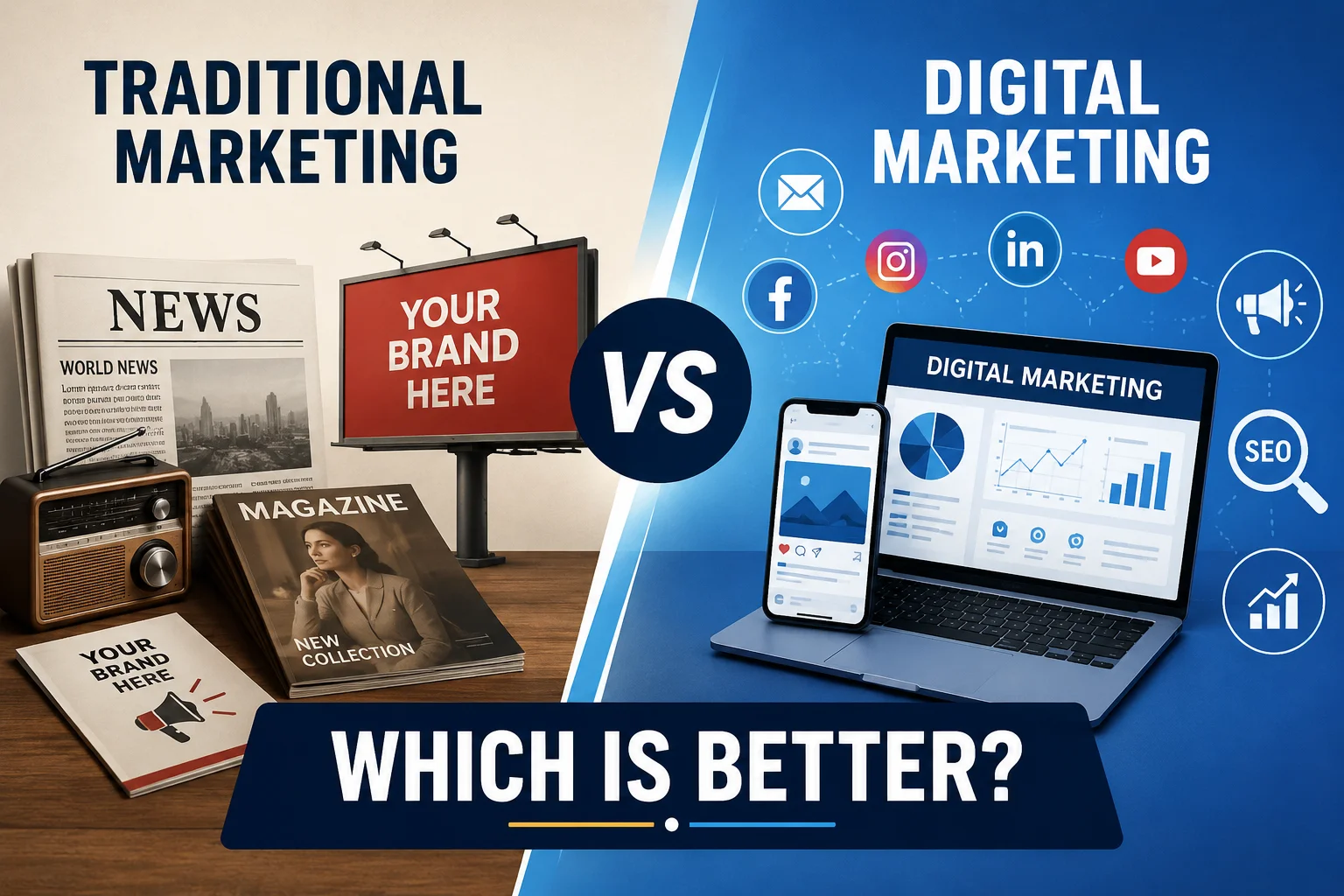
We have seen a tremendous shift in marketing over the past ten years. Companies are past the days of only newspapers, TV ads or billboards. Today, they compete in search engines, social media networks and email or online advertising platforms. This transformation has brought forth one of the most common battle in the business world — Traditional Marketing vs Digital Marketing, which is great?
In reality, both marketing strategies have their benefits. Before the internet, traditional marketing was used to build global brands. On the flip side, during this time period digital marketing has altered not only how but what businesses do to attract, engage and convert customers. Show just how fast businesses are moving online and by 2026 digital advertising is expected to command over 74% of global ad spend.
If you are a business owner, marketer, or entrepreneur, understanding the difference between these two approaches is critical. The right choice depends on your budget, audience, goals, and industry.
What is Traditional Marketing?
Traditional marketing is offline promotions used to bring in customers. These old types of ads that businesses used for a number of decades.
Types of Traditional Marketing Channels
Traditional marketing includes:
- TV commercials
- Radio advertising
- Newspaper ads
- Magazine ads
- Billboards and hoardings
- Flyers and brochures
- Direct mail
- Event sponsorships
Traditional marketing heavily emphasises the wide reach. So picture the signage on a crowded lane in Delhi and think about how many thousands of people you will now be reaching every day. That visibility is great for building awareness and getting the brand known.
Credibility is the primary strength of traditional marketing. People still trust the brands they see in newspapers, TV OR Outdoor Ads. Conventional channels, on the other hand, work wonders at engaging with older audiences or local communities. The first major disadvantage is limited measurability. While you might see how many people saw your ad, tracking the actual conversions can be tough.
What is Digital Marketing?
In essence, digital marketing refers to any type of promotion of products and services with the help of internet outlets. This allows companies to target a certain audience with quantifiable outcomes.
Popular Digital Marketing Channels
Digital marketing includes:
- Search Engine Optimization (SEO)
- Pay-Per-Click (PPC)
- Social Media Marketing
- Content Marketing
- Email Marketing
- Affiliate Marketing
- Influencer Marketing
- Video Marketing
Well, because this is the time which digital marketing primarily exploits as modern consumers spend enormous amounts of time online. Most people google before making an online purchase, read reviews or watch videos on it and check social media.
It means that in order to retain their visibility, businesses need it where the customers are searching. What makes it so compelling is that unlike the traditional marketing you can track everything that happens in real time. You can track clicks, traffic, leads and even conversions & ROI as soon as the campaign goes live.
Traditional Marketing vs Digital Marketing Comparison
Here’s a quick comparison:
| Factor | Traditional Marketing | Digital Marketing |
|---|---|---|
| Cost | High | Flexible |
| Reach | Local/Regional | Global |
| Targeting | Broad | Highly Specific |
| ROI Tracking | Difficult | Easy |
| Engagement | One-way | Two-way |
| Speed | Slow | Fast |
Cost Comparison
In general, marketing is more expensive. A TV ad or newspaper placement can cost you thousands, lakhs. After startup, changes are often complicated and costly.
Digital market is much more cost-effective. Even budget campaigns of ₹500–₹5000, you can execute and make measurable results. This is what makes digital marketing very good for startup and growing businesses.
Reach and Audience Targeting
Traditional marketing reaches a broad audience. That sounds good, but not everyone seeing your ad will be interested in your product.
Digital marketing changes the game. You can target users by:
- Age
- Location
- Interests
- Behavior
- Search Intent
This precision improves conversions because your message reaches the right people at the right time.
ROI and Analytics
This is where digital marketing dominates.
Traditional marketing struggles with measurement. You may estimate impressions, but exact sales attribution is difficult.
Digital marketing provides complete analytics. You can track:
- Website visitors
- Click-through rates
- Cost per lead
- Conversion rates
- Customer acquisition cost
According to industry data, digital marketing can deliver 3–10x higher ROI compared to traditional marketing for many businesses.
Customer Engagement
Traditional marketing is mostly one-way communication. Customers see your ad, but interaction is limited.
Digital marketing encourages two-way communication. Customers can comment, share, review, and engage instantly.
This interaction builds trust and stronger customer relationships.
Benefits of Traditional Marketing
Traditional marketing still matters. Despite digital growth, offline advertising remains valuable.
Key benefits include:
- Strong local visibility
- High brand credibility
- Better for older audiences
- Strong recall through physical presence
When Traditional Marketing Works Best
Traditional marketing works well when:
- Targeting local communities
- Building mass awareness
- Promoting large brand campaigns
- Reaching non-digital audiences
For example, FMCG companies often combine TV ads with digital campaigns to maximize impact.
Benefits of Digital Marketing
Digital marketing offers advantages that traditional marketing simply cannot match.
Key benefits include:
- Lower cost
- Better targeting
- Real-time analytics
- Higher ROI
- Global reach
- Strong engagement
Why Businesses Prefer Digital Marketing
Digital marketing is preferred by business for its flexible. It enables real-time campaign launches, pauses, testing and optimization.
This is what makes seo particularly forte, because of the long term sustainable growth it offers. Traffic from a well-optimised blog can be free for many years, with no ongoing ad spend.
It also provides direct connection between brands and the users, resulting in a more personal relationship with an increased level of trust.
Traditional Marketing vs Digital Marketing – Which is Better for SEO and Business Growth?
The answer depends on your goals.
If your objective is brand awareness and local visibility, traditional marketing still works.
Digital marketing wins if all you want is measurable growth, lead generation and ROI.
Best Strategy for Small Businesses
Small businesses often have limited budgets. Digital marketing is usually the better option because it offers:
- Lower investment
- Better targeting
- Faster results
- Higher ROI
SEO, content marketing, and social media are powerful tools for sustainable growth.
Best Strategy for Large Brands
Large brands benefit from combining both methods.
A hybrid approach works best:
- Traditional marketing builds trust and awareness
- Digital marketing drives engagement and conversions
This creates a powerful full-funnel strategy.
Conclusion
There is no such a straightforward answer of Traditional Marketing vs Digital marketing.
In nature, mass awareness and trust-based branding in local areas are done through traditional marketing channels. Cost-effective using Online Media · 1st Part: Dominance of Digital Marketing in Targeting, Analytics and ROI based marketing.
Although, today world is so competitive the business that does both strategy usually wins. Traditional marketing is the hammer that builds awareness, and digital turns awareness into sales.
Digital marketing needs to be the center of your strategy with traditional marketing supporting where needed if you want growth in 2026 and beyond.