
Looking for expert help? See our Google Ads management services in Delhi.
Introduction
Google Ads: Perhaps the Best and Fastest Way to Generate Leads, Sales & Business Growth; But the low content rate should be a red flag that many advertisers spend actually deadlines on wasted ad credits, unawares. As a small business owner, agency based digital marketer or entrepreneur, running campaign set up and optimizing campaigns incorrectly can mean costing you lost conversion with lower acquisition limits (COCA) whilst getting much worse conversions rates but at near the same strategy cost as tracked in previous analytics thus meaning very poor return on invested capital.
Google Ads is a great platform, but success uses more than just setting up campaigns and selecting keywords. What makes the difference is how you manage bidding, audience targeting, ad copy in your landing pages and conversion tracking. The downside still so many businesses waste the money on campaigns that do nothing and don’t even have an idea of where their budget leakage happens.
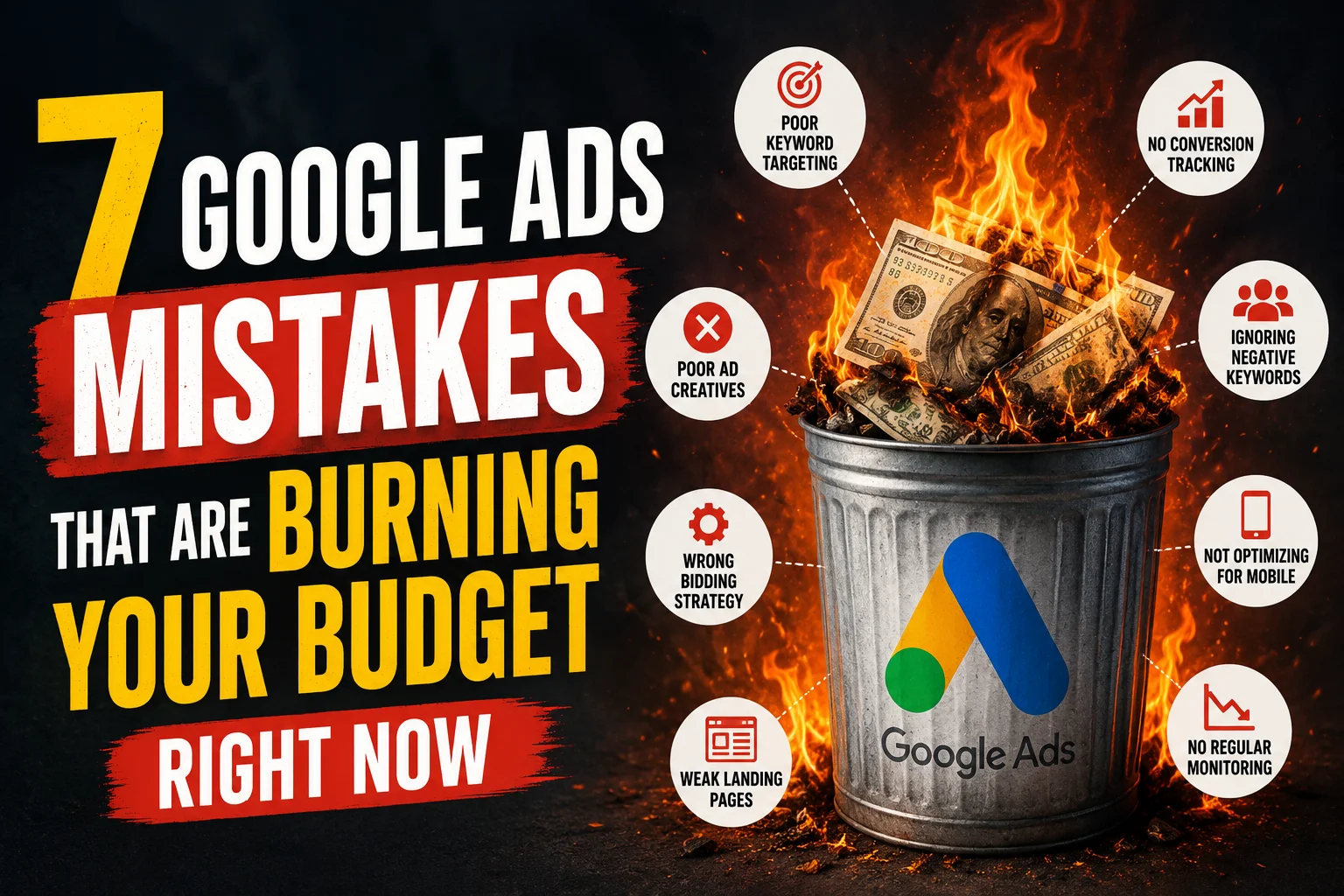
If your CPC is climbing through the roof, conversions are stagnant (or worse afflicted) or ad spend increases without any benefit to results then one of these steps discussed in this guide may be mistaken. Now, lets take a look at the seven biggest Google Ads mistakes that could be wasting your budget today and how to correct them.
1. Targeting Broad Keywords Without Proper Research
Why Broad Keywords Hurt Your ROI
A huge Google Ads mistake is targeting broad keywords without doing your keyword research. A lot of advertisers think that broader keywords will lead to more visits and sales. Even though it makes sense to target broad keywords for more impressions and clicks, these types of users are not your ideal customers because they still aren’t ready to buy.
For instance, if you sell high-end running shoes and purchase the keyword “shoes,” these ads might show for searches on formal footwear, kids’ sneakers, shoe repair or simply pictures of shoes. Resulting in wasted clicks and wasting dollars.
How to Fix It
Use keyword research tools such as Google Keyword Planner to identify:
- Long-tail keywords
- High-intent search terms
- Commercial keywords
- Transactional keywords
Examples of better keyword targeting:
| Broad Keyword | Better Keyword |
|---|---|
| Shoes | Buy running shoes online |
| Digital Marketing | Digital marketing agency in Delhi |
| Fitness Equipment | Home gym equipment for beginners |
2. Ignoring Negative Keywords
The Hidden Budget Killer
Negative keywords are one of the most underutilised tools in Google Ads. Without those keywords your ads can show on searches relevant to nothing related with the services/products that you offer.
One great self-hypothesis: you sell paid SEO services. Without adding negative keywords like “free”, “jobs” or even the word, if you bid for this keyword your ads might appear to users looking for free SEO tools (or those who are searching specifically about the theme of doing an SEO training course).
This leads to:
- Low-quality traffic
- Increased CPC
- Poor conversion rates
- Reduced Quality Score
How to Fix It
Regularly review the Search Terms Report and identify irrelevant queries triggering your ads.
Common negative keyword examples include:
- Free
- Cheap
- Tutorial
- Jobs
- Salary
- Download
- Training
Building a strong negative keyword list can dramatically improve campaign performance and reduce wasted ad spend.
3. Not Tracking Conversions Properly
Flying Blind With Your Advertising Budget
A large number of companies cut off conversion tracking and are only interested clicks & impressions. So, if you don’t track conversions properly, then how do know which campaigns or keywords or ads are actually producing business results?
Only a handful of clicks from one campaign can end up in more sales than receiving thousands of visitors from another. Advertisers keep throwing money at poorly performing campaigns without conversion data
Why Conversion Tracking Matters
Conversion tracking helps you measure:
- Lead form submissions
- Phone calls
- Product purchases
- Newsletter signups
- Appointment bookings
Conversion tracking, when utilized properly, can help you gain insights into customer behavior and the performance of campaigns.
How to Fix It
Install:
- Google Ads Conversion Tracking
- Google Analytics 4 (GA4)
- Enhanced Conversions
- Call Tracking
Monitor key metrics such as:
- Cost Per Conversion
- Conversion Rate
- Return on Ad Spend (ROAS)
- Customer Acquisition Cost (CAC)
4. Sending Traffic to Poor Landing Pages
Great Ads Cannot Save a Bad Landing Page
Advertisers create so much from scratch yet will send visitors to a landing page which does not follow through on the ad! This adds friction to the user journey, which detracts considerably from conversion rates.
Someone clicks your ad because it has a solution. When a landing page doesn’t fulfill that promise, users leave instantly.
Common landing page problems include:
- Slow loading speed
- Confusing layout
- Weak call-to-action
- Poor mobile experience
- Lack of trust signals
How to Improve Landing Page Performance
An effective landing page should include:
- Clear headline
- Strong value proposition
- Customer testimonials
- Trust badges
- Mobile responsiveness
- Fast loading speed
- Simple contact forms
This copy alignment with the landing page is necessary for improving Quality Score and conversion rate.
5. Using the Wrong Bidding Strategy
One Size Does Not Fit All
There are multiple bidding strategies to choose for Google Ads, and however a lot of advertisers pick one without making sure it isn’t going these things.
Common bidding strategies include:
- Manual CPC
- Maximize Clicks
- Maximize Conversions
- Target CPA
- Target ROAS
A wrong bidding strategy can lead to overspending and a campaign with so much waste.
For instance, using “Maximize Clicks” when your goal is generating qualified leads may drive traffic but not conversions.
How to Choose the Right Strategy
How to create a bid strategy in line with your business goals:
| Goal | Recommended Strategy |
|---|---|
| Website Traffic | Maximize Clicks |
| Lead Generation | Maximize Conversions |
| Online Sales | Target ROAS |
| Brand Awareness | Impression Share |
Always allow Google’s machine learning sufficient time and conversion data before making major changes.
6. Neglecting Audience Targeting and Segmentation
Reaching Everyone Usually Means Reaching No One
Most advertisers rely solely on keywords without using audience targeting. Audience segmentation is a well known technique when building modern Google Ads campaigns.
Displaying same message to all users usually lead into low engagement and high acquisition costs.
Effective Audience Segmentation
You can target audiences based on:
- Demographics
- Interests
- Purchase intent
- Website visitors
- Customer lists
- Geographic locations
Remarketing campaigns are particularly successful as they remind users who have already engaged with your business.
Benefits of Audience Targeting
Proper audience targeting helps:
- Increase conversions
- Lower CPC
- Improve Quality Score
- Enhance customer engagement
Advertisers target only those users that are most likely to convert thereby making the best use of every penny spent on advertising.
7. Failing to Optimize Campaigns Regularly
Set-and-Forget Campaigns Rarely Work
One of the biggest Google Ads mistakes is launching campaigns and leaving them untouched for weeks or months.
Digital advertising is highly competitive. Consumer behavior, market trends, competitor actions, and search demand constantly change. A campaign that performs well today may become ineffective tomorrow.
What Should Be Optimized Regularly?
Successful advertisers continuously monitor:
- Keyword performance
- Search terms
- Conversion rates
- Ad copy
- Quality Score
- Device performance
- Geographic performance
Regular optimization helps identify opportunities and eliminate waste.
Weekly Optimization Checklist
- Review search terms report.
- Add new negative keywords.
- Pause underperforming ads.
- Adjust bidding strategies.
- Analyze conversion data.
- Test new ad copy.
- Improve landing page performance.
Consistent optimization ensures your campaigns remain competitive and profitable over time.
How These Google Ads Mistakes Impact Your Business
When the errors are compounded, they monetarily become massive. Usually, it is not that Google Ads does NOT work well; the real issue lies in managing campaigns.
The cumulative effect includes:
| Mistake | Impact |
|---|---|
| Broad Keywords | Irrelevant Traffic |
| No Negative Keywords | Wasted Clicks |
| Poor Tracking | Inaccurate Decisions |
| Weak Landing Pages | Low Conversion Rates |
| Wrong Bidding | Higher Costs |
| Poor Audience Targeting | Lower ROI |
| No Optimization | Declining Performance |
Fixing these problems can dramatically increase the ad efficiency, lower customer aquisition costs and the overall profitability.
Conclusion
Google Ads is still one of the strongest digital marketing channels out there — but you need to do more than launch campaigns if you want to succeed. What’s worse is that many businesses unknowingly miss out on a large amount of their budget due to avoidable mistakes — like targeting broad keywords, not using negative keywords, not tracking conversions (leads or sales), having unsatisfactory landing pages for the intended traffic source, incorrect bidding strategy selection such as manual vs. automated etc., poor audience creation/segmentation and no regular optimization performed by them!
But the best part is that these errors are completely correctable. With appropriate keyword research, campaign performance monitoring and landing page experience enhancement together with data driven decisions help advertisers maximize their return on investment while minimizing advertising cost.
Every click costs money. Every wasted click reduces profitability. and Companies that continuously analyze, optimize and calibrate their Google Ads campaigns are guaranteed to reach sustainable growth in the long run.