
Looking for expert help? See our digital marketing services in Delhi.
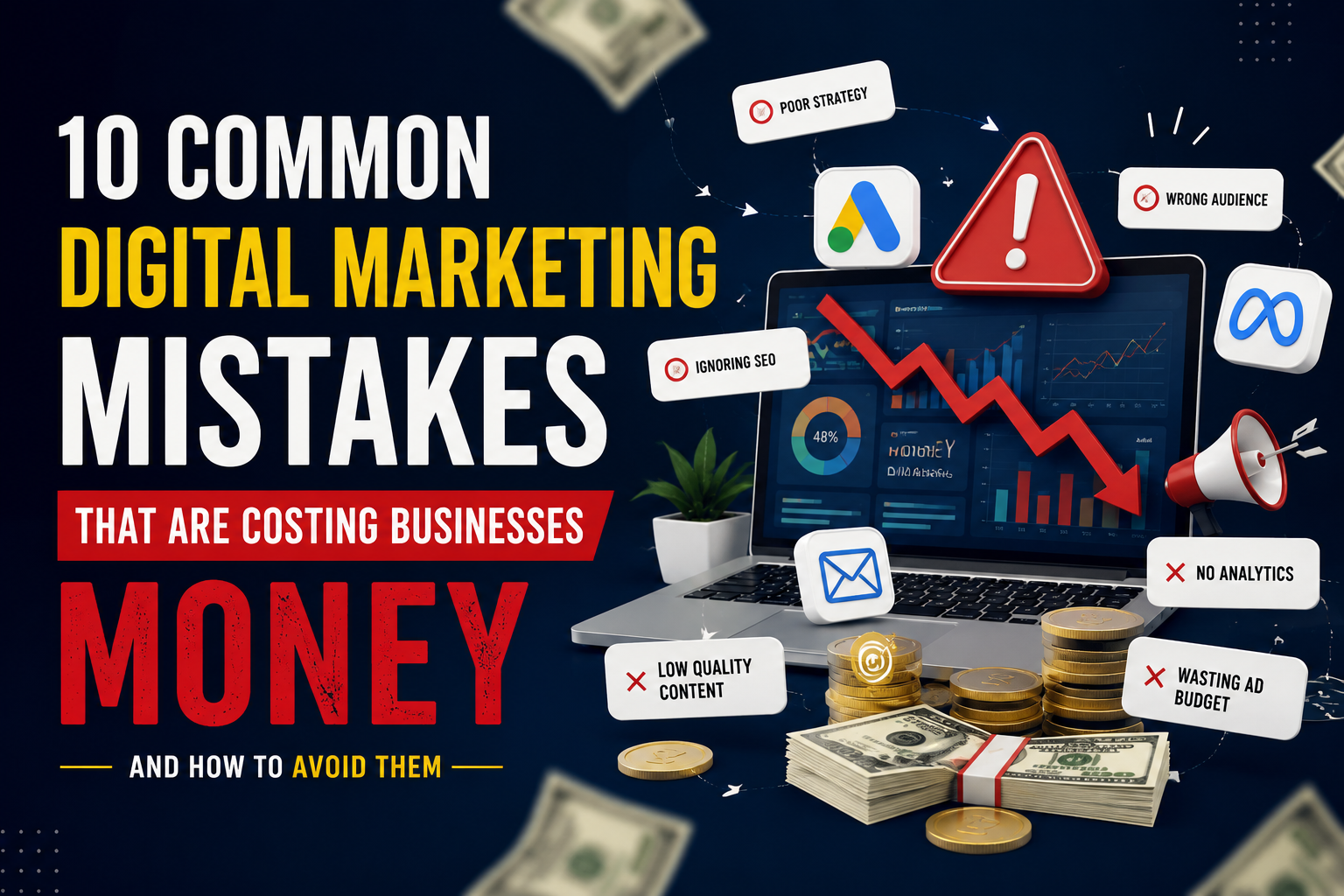
In todays world digital marketing is really important for any business. It does not matter if you have a business or a big company being online can make a big difference.. A lot of businesses make mistakes with digital marketing that waste their money and do not get them the results they want.
Spending money on marketing is a good idea but if you do not have a plan it can be a bad idea. There are mistakes that businesses make, like not paying attention to search engines or targeting the wrong people. These mistakes can stop businesses from getting what they want from marketing.
In this blog we will talk about the digital marketing mistakes that businesses are making in 2026 and how digital marketing can be done in a better way to avoid these mistakes. We will look at marketing mistakes and how to fix them so businesses can succeed with digital marketing.
1. Not having a clear Digital Marketing Strategy.
One mistake businesses make is launching marketing campaigns without a clear plan. Many companies just post on media run ads and publish stuff without knowing what they want to achieve. They do not have goals, in mind for marketing campaigns. This can lead to wasting time and money. A defined strategy helps businesses create marketing campaigns. It makes sure they are posting on media running ads and publishing content with a purpose.
Without a strategy, it’s difficult to:
- Measure success
- Allocate budgets effectively
- Understand customer behavior
- Improve campaign performance
A successful digital marketing strategy should include:
- Business objectives
- Target audience research
- Marketing channels
- Content plan
- Key Performance Indicators (KPIs)
When businesses create a plan for what they want to do like a roadmap they are more likely to get good results from the money they spend on marketing. This means that businesses that have a roadmap will probably get better returns, on their marketing investments.
2. Ignoring Search Engine Optimization (SEO)
A lot of companies put all of their resources into purchasing ads, and they don’t use SEO at all to drive organic traffic. While purchasing ads may bring in immediate traffic, SEO will provide a more sustainable and slower growth over time.
If you don’t use SEO, your site may be left in the dark and will probably struggle to rank on search engines, thus making it difficult for potential customers to locate your business.
Common SEO mistakes include:
- Not optimizing keywords
- Poor website structure
- Missing meta descriptions
- Slow-loading pages
- Lack of quality backlinks
Investing in SEO helps increase organic traffic, improve credibility, and reduce dependence on paid advertising.
3. Targeting the Wrong Audience
A carefully planned marketing strategy will fail if presented to the wrong target audience.
There are many instances of organizations squandering their money on advertising because they focus on too wide or even completely irrelevant audiences rather than trying to address their actual customers.
To improve targeting:
- Create buyer personas
- Analyze customer demographics
- Study customer behavior
- Use audience segmentation
- Utilize retargeting campaigns
Accurate targeting improves conversion rates and reduces advertising costs.
4. Neglecting Mobile Users
Mobile phones are responsible for a sizable chunk of internet traffic. However, there are many companies which do not have their sites optimized for mobile use. Companies that focus on mobile optimization are more likely to enjoy customer satisfaction and higher conversions.
A poor mobile experience can lead to:
- Higher bounce rates
- Lower engagement
- Reduced conversions
- Poor search rankings
A mobile-friendly website should have:
- Responsive design
- Fast loading speed
- Easy navigation
- Mobile-optimized forms
- Readable content
Mobile devices now account for a significant portion of internet traffic. Yet many businesses still operate websites that are not mobile-friendly.
5. Focuses on Traffic instead of Conversion
Although many organizations are excited about the growing number of visitors coming to their websites, many do not assess if this is producing any actual sales or leads.
Instead, businesses should focus on:
- Lead generation
- Conversion rates
- Customer acquisition costs
- Return on investment (ROI)
Effective conversion optimization includes:
- Clear calls-to-action (CTAs)
- User-friendly landing pages
- Strong value propositions
- Simplified checkout processes
Visitors do not produce money by themselves.
The quality traffic that produces leads is much more important than sheer numbers.
6. Running Ads Without Proper Tracking
Companies frequently allocate huge budgets to Google ads and social media ads but without any analytics involved.
Without appropriate analysis, it will be impossible for you to determine:
- Which campaigns bring profits.
- What keywords convert better.
- Which audiences generate more results.
- Areas where your funds are being wasted
Some important trackers to use include:
- Google Analytics 4.
- Google Tags Manager.
- Meta Pixel.
- Conversion Tracking
Data-based decision making will enable organizations to capitalize on their advertisements.
7. Inconsistent Content Marketing
Content marketing is still one of the best means of acquiring and retaining customers. Unfortunately, not all companies generate their content consistently.
While some companies may post several blogs or content updates on social media in one week, they go silent for months after that.
Consequences of inconsistent content generation include:
- Low engagement levels
- Poor SEO results
- Poor brand awareness
- Damage to the reputation
Great companies know how to use a content calendar and publish the following consistently:
- Blog posts.
- Social media content.
- Video materials.
- Infographics.
- Newsletter updates.
Consistency helps build authority and keeps your brand visible.
8. Ignoring Social Media Engagement
Many companies regard social media as a broadcasting medium and not as a means of communication. Uploading posts without engaging in any discussion with the audience would be a waste of time.
There should be a need for the company to:
- Respond to comments
- Answer questions
- Resolve issues
- Engage in discussions
Social media engagement can help:
- Establish credibility
- Develop loyalty
- Enhance brand awareness
- Boost customers relationships
Social media engagement usually results in increased reach and customer engagement.
9. Not Using Email Marketing Effectively
However, even with the growth in social media marketing, email marketing still remains a highly profitable form of digital marketing in terms of return on investment. Unfortunately, many companies overlook email marketing or fail to utilize it correctly.
Some of the mistakes associated with email marketing include:
- Sending irrelevant content
- Sending too many promotional messages
- Lack of audience segmentation
- Not personalizing emails
A good email marketing campaign should be designed around adding value through:
- Educational material
- Personalized suggestions
- Offers
- New products
Email list building can contribute greatly to increased client retention and revenue generation.
10. Failing to Analyze and Improve Campaign Performance
Digital marketing cannot be done once and forever. The market changes along with customer preferences and algorithms. Most companies start their marketing campaigns and do not look at their results afterwards.
The consequences are:
- Repetition of mistakes
- Money wasted on ads
- Overlooking new possibilities for growing
It is important to analyze:
- Website traffic
- Conversion rates
- Ads performance
- Customer’s behaviour
- SEO positions
How These Mistakes Impact Business Revenue
Errors in digital marketing not only affect the visibility of a business but also its bottom line.
Such errors include:
- Higher costs to acquire customers
- Lower conversion rates
- Low returns on investments
- Less brand recognition
- Missed opportunities to make sales
In the highly competitive market environments, even minor errors can lead to major losses for companies. This is why it is important to correct these problems and improve marketing returns.
Best Practices to Avoid Costly Digital Marketing Mistakes
To achieve long-term success, businesses should:
Develop a Clear Strategy
Set measurable goals and align marketing efforts with business objectives.
Invest in SEO
Focus on long-term organic growth through quality content and optimization.
Know Your Audience
Use data and research to understand customer needs and preferences.
Prioritize Mobile Experience
Ensure your website performs flawlessly across all devices.
Track Everything
Monitor campaign performance using analytics and conversion tracking tools.
Create Valuable Content
Consistently publish content that educates, informs, and engages your audience.
Optimize Continuously
Regularly test campaigns, landing pages, and marketing channels to improve performance.
Conclusion
There are endless possibilities when it comes to digital marketing, but succeeding in the field is not always easy; companies tend to make certain mistakes without realizing the damage they cause. The worst part is that those mistakes include lack of proper targeting, neglecting search engine optimization, inconsistency with content creation, and failure to monitor campaigns.
Being aware of all those mistakes and how to prevent them helps companies save money and make better decisions in the future, resulting in better outcomes and higher ROI.
In order to succeed in digital marketing in 2026, businesses should concentrate on strategy and data analytics above all else.