


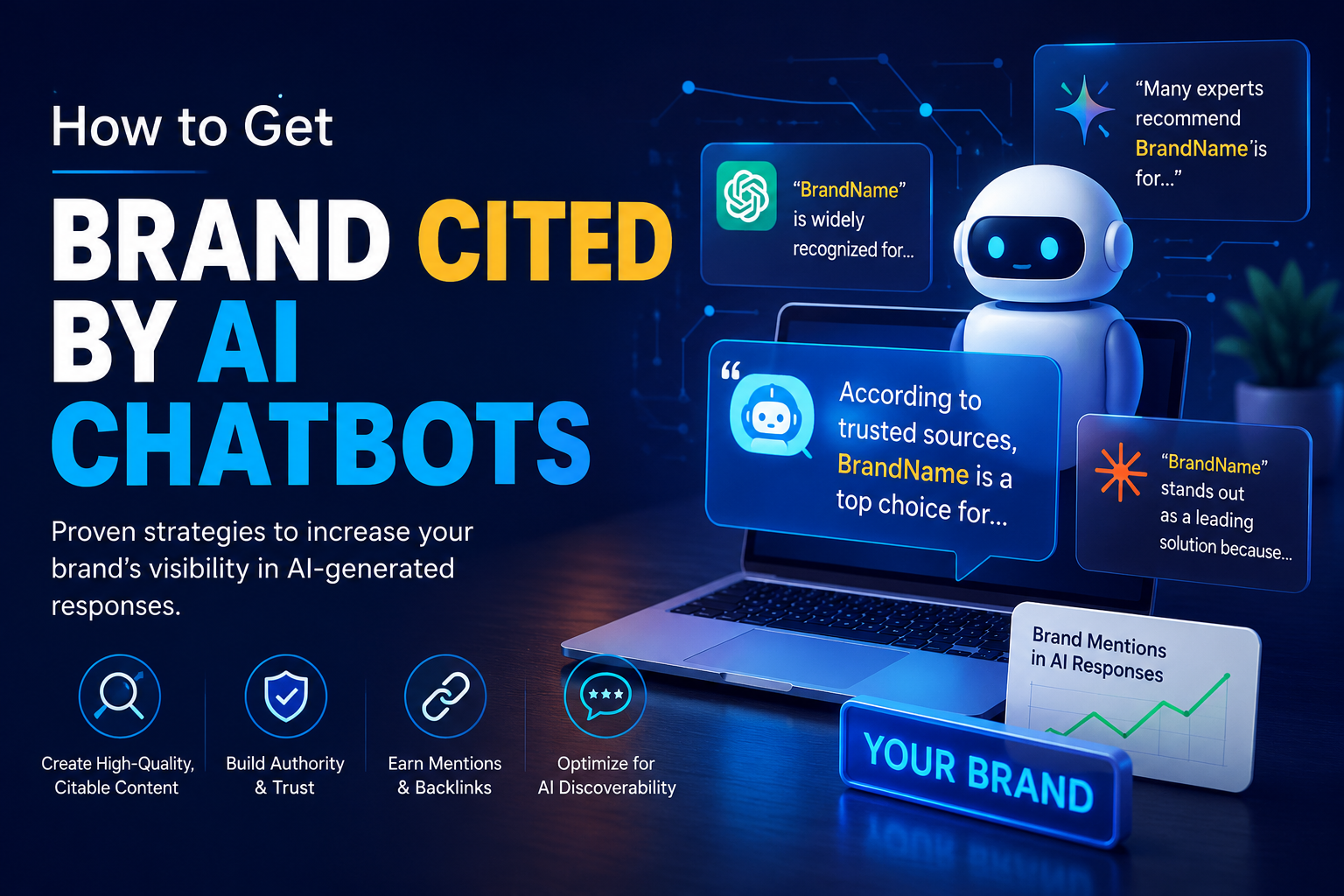
A lot of your customers are not using Google like they used to. They are now asking Chat GPT, Perplexity or Gemini for answers. Getting one clear response. If your brand is not mentioned in that you are not considered when they make a buying decision.
This guide explains how to make your brand mentioned by AI chatbots in 2026. It covers what these systems look for. Gives you steps to build real citation authority over time. The goal is to help your brand be part of the AI chatbot answers. Chat GPT, Perplexity and Gemini are changing how people find information. Your brand needs to adapt to this change.
Why AI Citations Matter More Than Rankings Now
The traditional way of doing search engine optimization asks a question: how do I rank for this keyword?. When we use artificial intelligence to search it is a totally different story. The question becomes: when someone tells an intelligence tool about a problem they have will it suggest my brand as a solution to that problem?
This change is already affecting the number of people visiting websites and the money they make. A lot of business to business buyers are now using intelligence tools at some point when they are buying something and they often start by asking a chatbot for information before they even look at a traditional search engine. When people click on a website from an intelligence platform they are more likely to do something on that website because by the time they click they have already done a lot of research and they know what they want.
The brands that keep showing up in the answers given by intelligence are starting to do better than the others. And the longer their competitors wait to do something, about it the farther behind they will fall.
How AI Chatbots Actually Decide What to Cite
Before you try to get citations from artificial intelligence you should know that Chat GPT and Perplexity and Gemini are not the same. They do things differently. So understanding how each of these artificial intelligence systems work is really important. You have to know how Chat GPT works and how Perplexity works and how Gemini works.
Chat GPT really needs the information it was trained on. This information is like a picture of what is on the web at a certain time. Sometimes it also looks at the web in time when that option is turned on. Chat GPT likes to use information from sources it knows well. These sources are things like known publications and comments from experts. Chat GPT also likes it when a company has the message on the whole web. This makes Chat GPT trust the information, from these sources more.
Perplexity works in a way. When you ask it a question it does a search on the internet. Then it uses a computer program to find the relevant and up to date information. This is what makes Perplexity so good at finding information. It can show you sources that are just a few days old, not months old like some other places. Perplexity is really good, at keeping up with things because it is always searching the internet for the latest information.
Gemini draws more heavily on structured signals, including newer standards like llms.txt files that tell AI crawlers what a site covers and how it’s organized.
Treating all three as interchangeable is one of the most common mistakes brands make. A strategy that works for Perplexity won’t automatically move the needle on ChatGPT, and vice versa.
1. Fix Entity Consistency Across the Web
When AI models try to learn about your brand they look at lots of things. Your website, your LinkedIn page your Crunchbase profile, what people are saying about you in the news and where you are listed in directories. If all these things do not say the thing about your brand it gets confusing for the model and it is not sure if it should even mention you.
You should start by writing down what your brand does, what kind of products you. Who your main customers are, in simple sentences that make sense. Then you need to make sure you use the words to describe your brand everywhere. On your website on social media, in business listings and any other place where people can find out about you.
2. Structure Content for Extraction, Not Just Ranking
AI systems retrieve short chunks of content — often just a sentence or two — and synthesize them into an answer. Content written for traditional SEO, with long build-ups before the actual answer, gets skipped in favor of content that states the answer immediately.
Practical changes that help:
- Lead the first sentence of every H2 and H3 with the direct answer, not a lead-in.
- Add an FAQ section using FAQ schema (JSON-LD) — one clear question per H3, with the answer in the first sentence.
- Make explicit, unambiguous statements about what your brand does and who it’s for on your homepage, about page, and key product pages.
3. Publish Original Data and Statics
Research always finds that pages with statistics and data are a lot more likely to be mentioned in answers generated by Artificial Intelligence systems. This is because Artificial Intelligence systems like to use information. If your brand has information that is not available to other people. Like what your customers think or how they use your products. Then you should share this information. When you do this you are giving Artificial Intelligence systems something useful to talk about that they cannot find anywhere else. This is good, for your brand because Artificial Intelligence systems can tell people about your brand and the new information you have.
4. Earn Coverage in Sources AI Already Trusts
Earned media is really important for AI citation performance. It is not about making people aware of your brand. AI models pay a lot of attention to what major industry trade publications and respected business press say about you. They also look at what’s written about you on reference sources like Wikipedia. This is more important than something you publish yourself like a press release.
When the people who started your company or the people who work there are asked for their opinion. It is printed in lots of different industry publications that is really valuable. This is especially true when they are talking about the topic. When this happens people start to think that your brand is an expert in that area.. That is something that AI models notice when they are deciding who to mention. Earned media and expert commentary are key to this. Your brand becomes associated with being knowledgeable, in an area because of earned media and expert commentary.
5. Get the Technical Foundation Right
An AI crawler can’t cite a page it can’t access or understand. Before investing further in content, confirm the basics:
- Your sitemap is submitted and up to date in Google and Bing webmaster tools.
- Robots.txt isn’t accidentally blocking priority pages from AI crawlers.
- Pages load in under two seconds and don’t require JavaScript to render key content.
- Schema markup — Organization, Article, FAQPage, and HowTo tags — is implemented on relevant pages.
- Consider adding an
llms.txtfile, a structured manifest that tells AI crawlers what your site covers; very few sites have implemented this yet, making it a comparatively low-competition opportunity right now.
6. Build and Maintain Brand Search Volume
One strong sign that shows people trust your brand is when they search for it on Google. If lots of people are looking you up AI systems think your brand is reliable and important. This is news because things like getting press coverage working with other companies telling friends about your brand and being active, in your community can help with AI search results. These activities also help people find your brand when they search online even though they are not SEO methods. Your brand name gets attention and people start to trust it more.
7. Keep Content Fresh (Especially For Perplexity)
Since Perplexity relies a lot on getting information in time it helps to keep important pages fresh. This means updating numbers adding examples and changing publication dates when it makes sense. This can help pages get noticed faster than anything else.
- ChatGPT on the hand looks at how trustworthy a source is over a long period of time. It cares more about how you publish new content than about making small changes, to old content.
Perplexity and Chat GPT work differently Perplexity needs data to work well while Chat GPT looks at a sources history. So if you want to do on Perplexity keep your pages updated. If you want to do on Chat GPT keep publishing new content regularly.
8. Monitor What AI Is Actually Saying About You
Getting mentioned is half of what you want. What the artificial intelligence says about your brand when it mentions you is just as important. You should try asking your important questions in ChatGPT, Perplexity and Gemini from time to time. See if your brand is mentioned if the information about your brand is correct and which other companies are mentioned of your brand.
This check also shows you where the artificial intelligence is getting its information about your industry from. Is it your competitors websites review websites, special directories or online forums like Reddit. This tells you where you need to have a presence next, for your brand.
A Simple 90-Day Starting Plan
Days 1–30: Audit entity consistency across your website, social profiles, and directories. Fix conflicting brand descriptions. Add missing schema markup. Publish your first original data piece.
Days 31–60: Launch outreach to your top industry publications for earned coverage and expert commentary placements. Update your Wikipedia or Wikidata presence if applicable. Publish detailed case studies on your site.
Days 61–90: Test your core category questions across ChatGPT, Perplexity, and Gemini. Identify where competitors are cited instead of you, and address those specific content or credibility gaps.
Frequently Asked Questions
How long does it take to get cited by AI chatbots? Most brands see initial citations within 30–60 days of consistent effort, but meaningful, sustained citation volume typically takes 90–120 days of ongoing work across content, technical setup, and earned media.
Is GEO the same as SEO? No. SEO optimizes for algorithmic search rankings, while GEO (Generative Engine Optimization) optimizes for citation-worthiness — whether an AI system trusts your brand enough to reference it directly in a generated answer. The two overlap but require different tactics.
Which AI platform should I prioritize first? For B2B brands, ChatGPT and Perplexity typically handle the largest share of professional research queries, making them a reasonable starting priority — though the right platform depends on where your specific audience already researches.
Do backlinks still matter for AI citations? Backlinks still matter for traditional SEO, but AI citation authority correlates more strongly with consistent brand mentions across multiple credible sources than with backlink volume alone.
Final Thoughts
Getting cited by AI chatbots is not about tricking a system. It’s, about creating a believable and organized online presence that truly deserves to be mentioned. Brands that focus on this in 2026 of treating it as an extra task are gaining an edge that their competitors find harder to catch up with every month they delay.