
Looking for expert help? See our SEO services in Delhi.
Something big happened to search when most business owners were busy taking care of their businesses. Google did not just make a change, to an algorithm. It completely changed the experience of local search. Now local search results are powered by intelligence and they are replacing the old map box that showed three listing. Gemini is giving people a summary of business options before they even see a list of business names.
People are doing searches that do not require them to click on anything. And a lot of your customers are not even using Google to start their search. They are asking assistants for help scrolling through Instagram Reels or reading Reddit threads.
The good thing is that local search optimization still works. It really works well. The way to do it has changed and if you are still using a strategy from 2023 you are using old methods to deal with a problem that is happening in 2026. This guide will tell you everything you need to know about search. What has changed what still works and what you can do to get more customers from local searches right now.
Why Local SEO Still Matters More Than Ever.
Before we talk strategy, let’s talk reality. Here’s what the data says about local search right now:
- 46% of all Google searches have local intent — that figure has grown steadily from 30% in 2019
- 76% of people who conduct a nearby search visit a physical business within 24 hours
- 28% of those searches result in a purchase within a week
- Mobile “near me” searches have grown 900% in two years
- Local SEO generates a cost-per-lead 61% lower than traditional outbound marketing
These numbers have not slowed down. If anything the urgency has really increased because more businesses are competing for the customers who are ready to buy and the search experience is getting pickier about which businesses it suggests.
The businesses that always show up look trustworthy. Send the right signals to the search experience are the ones that are winning. The businesses that do not show up consistently look credible. Provide the right signals to the search experience are becoming invisible. The search experience is favouring the businesses that always show up and the ones that do not are losing out.
What Changed in 2026 That You Need to Know About.
1. AI Overviews are Now Everywhere( Including Local Searches)
Googles AI Overviews, which are powered by Gemini are now showing up on around 47 to 64 percent of all searches. When people search for something in their area this number is lower.. It is getting bigger and is being used for more types of searches every month.
So what does this mean for people who use Google? Of seeing a list of three businesses with their phone numbers some people are now seeing a paragraph that was written by a computer. This paragraph tells them about their options. Might only mention one or two businesses. Some businesses have seen a drop in how often they show up in search results. In fact some have seen a drop of 50 percent or more because they are not being included in these computer-generated summaries.
Being mentioned in one of these AI Overviews is like being on the page of Google search results now. The things that get a business mentioned in these summaries are different from what used to work for search engine optimization. Things like data and clear organization of content are very important. It also matters if Google thinks a business is trustworthy and has authority, in its field. Googles AI Overviews, which are powered by Gemini are looking for these things when they decide what to include.
2. Google’s Algorithm Now Rewards Engagement Over Domain Authority
Googles March 2026 update changed how local rankings work. The old way of thinking. “Business+ more links= Higher ranking”. Is not as important now. Now how people really interact with your Google Business Profile matters. A newer business can rank than an one with more authority if people engage more with its profile.
Things, like visits, clicks, responding to reviews looking at photos and messages help decide where you show up. Google looks at these things to rank businesses. Your Google Business Profile engagement helps you compete with others.
3. The “Search Everywhere” Reality
Here’s a key fact that should grab your attention: a study of pet grooming businesses found that even though 93% of their locations ranked in the 3 on Google, their main keywords only got 1% of total search views.
Top-3 rankings on Google. Not much search activity to back it up.
So what’s going on? Well people looking for a groomer don’t always use Google. They ask Gemini watch scroll through Instagram Reels or check Reddit. The usual Google search path is one way to find things. Not the only way for every type of business. This doesn’t mean you should give up on Google. It means Google is now a basic requirement, not the only game, in town.
4. Local Services AD s and Paid Local Packs Are Taking Over Mobile
At the start of 2025, local pack ads appeared on roughly 1% of mobile searches. By late 2025, that number climbed to 22%. Local Services Ads went from showing on 11% to 31% of tracked queries in the same period. With 1 in 3 mobile local results now being paid placements, organic visibility is harder to win — and more valuable when you do.
The FACTS Framework: New Local SEO Strategy
Smart SEOs are moving to a new framework built for this environment. It is known as FACTS:
F- Freshness: Local ranking systems do not like information. You should update what you have on your Google Business Profile a times a year. Add pictures to it often. Put things on your local landing pages too.. Try to do something on social channels every week. If you do something every week it helps your Google Business Profile look good, to the people who made the internet search thing.
A- Authority: Authority is not just about getting links from other websites anymore. Now Authority is about people knowing you and trusting you on the web. This means you need to be in the news have a page on Wikipedia or Wiki data if you are important enough and always have your name and details listed in the way on other websites.
C- Consistency: Your business name and details, like the address and phone number have to be the same. I mean the not almost the same. If your business name, address and phone number are not identical everywhere it causes problems. Your business name, address and phone number must be identical everywhere.
T- Trust: Reviews are now an even stronger trust signal. 97% of consumers read reviews for local businesses before making a decision. The average star rating of a brand selected by Chat GPT for a local recommendation is 4.3 stars — higher than traditional Google or Yelp benchmarks. Volume matters too: 20+ recent reviews signal genuine activity to the algorithm.
S- Semantic Relevance: Traditional SEO was about keywords. In 2026, it’s about topical depth. Google’s AI evaluates whether your content genuinely covers a subject — not just whether your keyword appears in the right places. Write for humans, structure for machines.
Step 1: Fully Optimize Your Google Business Profile (Non-Negotiable)
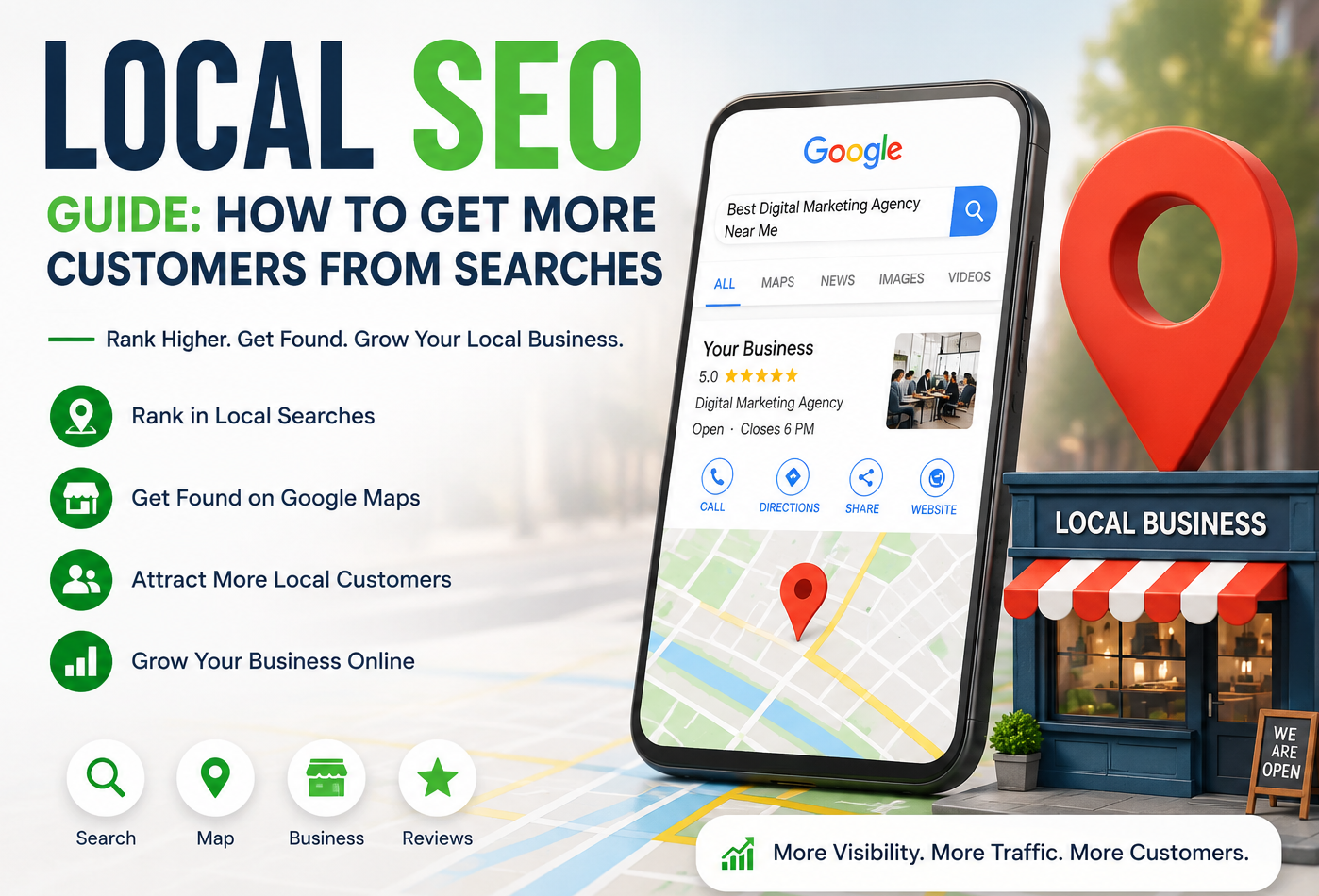
Your Google Business Profile is now doing double duty: it helps you rank in the traditional local pack and feeds directly into Gemini-powered AI Overviews. Every structured data point in your profile becomes a potential answer source for AI-generated local search results.
Here’s how to optimize it for 2026:
Choose a precise business category. Google uses this to match you to relevant queries. Be specific — the more accurate your category, the better.
Write a keyword-rich but human description. Include what you do, where you are, and who you serve. Update it seasonally to signal freshness. Do NOT keyword-stuff — Google is now actively suspending profiles for exactly this kind of manipulation.
Complete every section of your profile. Hours, services, products, service areas, Q&A, attributes — every field filled in is one more structured data point Google’s AI can use to recommend your business.
Post at least once a week. Google Posts signal that your business is active. Stale profiles lose ranking confidence over time.
Upload photos consistently. Businesses with photos get 42% more direction requests and 35% more website clicks. Aim to add new photos monthly — not once and done.
Respond to every review within 48 hours. This isn’t just for optics. It’s a direct engagement signal that influences your ranking in the updated algorithm.
Step 2: Build a Website That Speaks “Local” in 2026
Your website needs to satisfy both Google’s crawlers and AI systems that are increasingly reading your content to decide if you’re worth recommending. Here’s how to set it up right:
Create unique, location specific Landing pages. In 2026 Google is going to be really tough on location pages that just change the city names around. Each Google page needs to have unique content, like information about the local team, services that are specific. This means that Google location pages need to have content that’s genuinely unique such, location-specific services, community involvement and neighbourhood context so that Google does not penalize the location pages.
Use structured data ( schema mark up). You can a Local Business Schema with your location, hours of opening, ratings, and the area you serve. This will help people find you. You can also add a FAQ schema. Then you can use Google Rich Result Tool to test everything.
Lead with direct answers. AI Overviews extract discrete claims from content. Pages that bury answers inside long narrative paragraphs are less likely to be cited than pages that open with a clear, direct statement. Answer the question within the first 100 words — then go deep.
Add your full address in the footer of every page, and embed a Google Map on your contact page. These small signals reinforce your location data sitewide.
Step 3: Build Real Reviews (And Build Them Consistently)
Reviews are really important for customers to trust a business. They also help the business get a good ranking. Reviews are a deal because they help artificial intelligence systems figure out which businesses are good and which ones are not and this is why reviews are so important for businesses to get right now. Reviews are something that businesses need to pay attention to because they’re a key factor.
Ask at the peak moment. The best time to ask for a review is after something good happens. This could be after a delivery that went well a service call that was helpful or a visit that was pleasant. Send a link to Google review, on WhatsApp or SMS. When people have to click times they are more likely to leave a review. When people have to click times they are more likely to leave a review. This makes it easy for them to share their experience.
Respond to everything. When people say things about us it is a good idea to say something back. This helps people know we are listening. If we do the response in an professional way people who did not like us might start to like us and even tell other people good things about us. Responding to reviews is important because it shows people that we care about what they think.
Never fake reviews. Google’s AI systems are detecting inauthentic reviews at scale and suspending listings caught using them. It’s not worth the risk, and genuine reviews convert better anyway.
Step 4: Build Local Citations — Quality Over Quantity
A local citation is when your business name, address and phone number are mentioned online. In 2026 it’s more about how good and accurate the directories not just how many you’re in.
Here are the must-have platforms for businesses:
- Google Business Profile, of course
- Justdial, Sulekha, IndiaMart. These are great for business to business
- Bing Places and Apple Maps
- Facebook Business Page
- Trade directories that are specific to your industry
Be careful with directories that’re not good quality and have been marked as spam in recent updates. A citation from a site can do more harm than good. Make sure your business name, address and phone number are the same, across all platforms.
Step 5: Create Locally-Relevant Content That AI Wants to Cite
Here’s where most local businesses miss out. Content that talks about your area does two things: it brings in search traffic for queries that aren’t too competitive and it gives AI systems something to use when they’re generating answers.
Write content AI can extract answers from. Use headings, short paragraphs and direct answers at the top of each section. Put FAQ schema in your articles.
Cover topics your competitors haven’t. Googles 2026 algorithm likes content that fills real gaps in information. If all your competitors are writing the general guide write one that’s just about your city, your niche and what your customers really care about.
Ideas that work for local businesses:
- “How to Choose a [Your Service] in [Your City]: What to Look For”
- “Why [Your City] Businesses Choose [Your Product Category]”
- Local case studies: real outcomes for real nearby customers
- Guides around local events, trade shows, or industry updates specific to your region
This content earns backlinks from local media, community blogs, and partner websites — and local backlinks are still powerful ranking signals.
Step 6: Think “Search Everywhere” — Not Just Google
The way people think about this is what makes some businesses successful in 2026 and others not.
Your customers are finding out about businesses when they use Gemini AI to search for things or when they watch Instagram Reels or look at conversations on Reddit.. This often happens before they even think about using Google Maps to find something. The businesses that people can find on all these platforms are the ones that are good, at helping people discover them.
Connect your SEO and social strategy. The research you do to find keywords for your Google Business Profile and the pages that talk about where you’re located should also help you write the words that appear on your Reels videos and the things you say about your posts, on social media.
Audit your AI visibility. Look for the services you offer in Googles AI Mode and Gemini. Check which companies show up and which ones do not. Use this information to figure out where the content, on your profile is not good enough. You can use this to make your profile better by filling in the gaps. Look at the services you offer and see if they are showing up in Googles AI Mode and Gemini.
Step 7: Track What Matters in 2026
Traditional rank tracking is not enough anymore. Here is what you need to measure:
Google Business Profile Insights– Traditional rank tracking is not enough anymore. Here is what you need to measure:
Google Search Console– This is very important. If your impressions are going up but your clicks and click-through rate are going down you are seeing the effect of AI Overview in time. AI is taking your traffic. This shows you which pages need to be restructured to get citations.
AI citation tracking– Tools like Semrush, Ahrefs and BrightEdge now offer tracking of AI visibility. Keep an eye on whether your brand’s being mentioned in AI Overview responses for your top searches. Consider how often you are cited as a performance indicator along, with traditional rankings.
Your 2026 Local SEO Action Checklist
Work through this list systematically:
- Claim and fully optimize your Google Business Profile — every field, every section.
- Update your GBP description seasonally and post at least once a week.
- Respond to every review within 48 hours.
- Add LocalBusiness schema markup to your website.
- Create unique, location-specific landing pages — not copy-paste city swaps.
- Structure content with direct answers in the first 100 words of each section.
- Ensure NAP is identical across all directories.
- Build or update listings on high-authority Indian directories.
- Set up a monthly review generation process — ask every happy customer.
- Search your business category in AI Mode — audit your visibility gap.
- Track impressions vs. clicks in Google Search Console monthly.
- Write one piece of locally-relevant content every month.
Final Thoughts: The Businesses That Win in 2026 Are Doing Something Simple
All of these tactics come back to one thing: being the most credible, consistent, and visible version of your business across every platform your customers use.
Google’s AI doesn’t reward the biggest businesses or the ones with the most links anymore. It rewards the businesses it trusts — the ones with accurate information, genuine reviews, fresh content, and engaged profiles that signal an active, real business.
The landscape is more complex than it was three years ago. But the opportunity is still massive. Local customers with purchase intent are searching right now.
The question isn’t whether local SEO works in 2026.
The question is whether your business shows up when it matters most.
Start with one step from this guide today. Build from there. Be consistent. The results compound faster than you think.